河南农业科学 ›› 2026, Vol. 55 ›› Issue (8): 84-90.DOI: 10.15933/j.cnki.1004-3268.2026.08.009

• 植物保护 • 上一篇    下一篇

甲基硫菌灵和咯菌腈浸苗对收获期及储藏期甘薯黑斑病的防治效果

张德胜,王丽,田雨婷,王永江,乔奇,赵付枚   

  1. (河南省农业科学院 植物保护研究所/河南省农业有害生物监测与防控重点实验室/农业农村部华北南部作物有害生物综合治理重点实验室,河南 郑州 450002)
  • 收稿日期:2026-01-19 接受日期:2026-03-09 出版日期:2026-08-15 发布日期:2026-08-25
  • 通讯作者: 赵付枚,副研究员,博士,主要从事植物病害防控研究。E-mail:woshifumei@163.com
  • 作者简介:张德胜,副研究员,硕士,主要从事植物病害防控研究。E-mail:zhangdesheng404@163.com
  • 基金资助:
    国家甘薯产业技术体系项目(CARS-10);河南省科技攻关项目(252102110207)

Control Effect of Dipping Seedlings with Thiophanate‐Methyl and Fludioxonil on Sweet Potato Black Rot at Harvest and during Storage

Zhang Desheng,Wang Li,Tian Yuting,Wang Yongjiang,Qiao Qi,Zhao Fumei   

  1. (Institute of Plant Protection,Henan Academy of Agricultural Sciences/Henan Key Laboratory of Agricultural Pest Monitoring and Control/Key Laboratory of Integrated Crop Pests Management on Crops in Southern Region of North China,Ministry of Agriculture and Rural Affairs,Zhengzhou 450002,China)
  • Received:2026-01-19 Accepted:2026-03-09 Published:2026-08-15 Online:2026-08-25

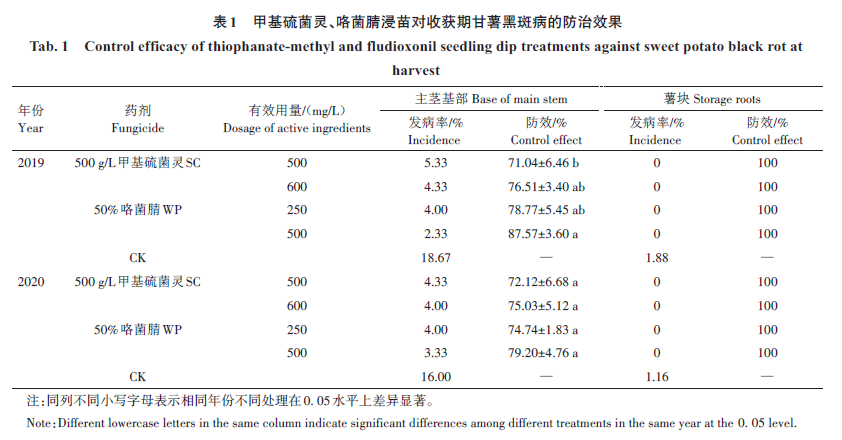
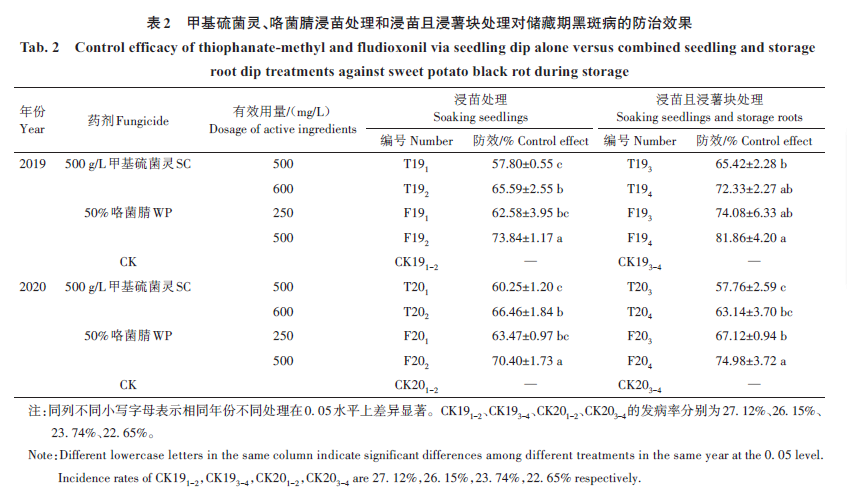
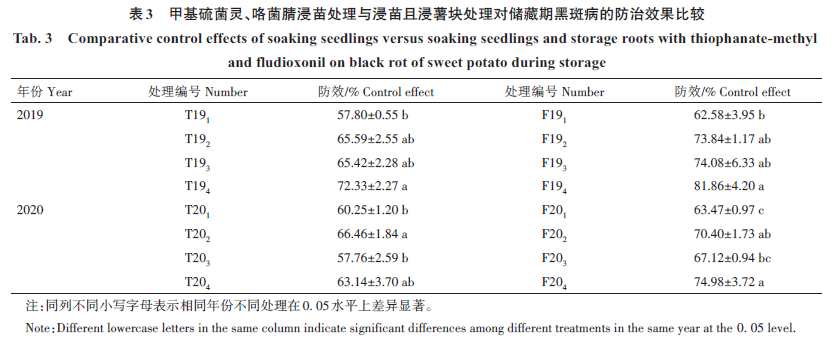
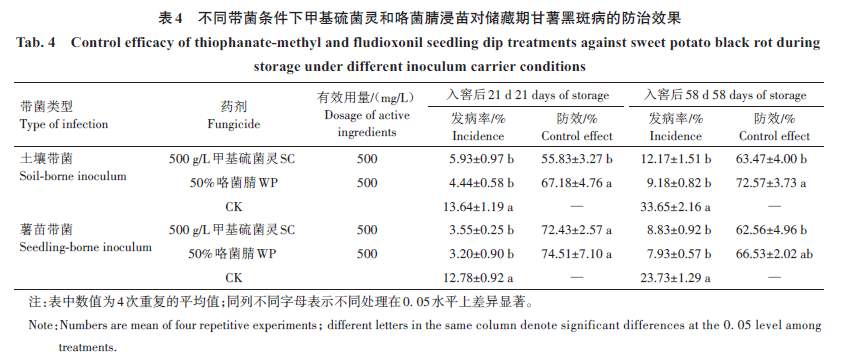
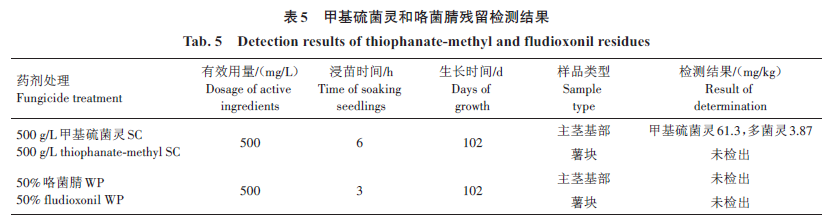
摘要: 为探讨药剂浸苗防治收获期及储藏期甘薯黑斑病的可行性,在土壤带菌或薯苗带菌条件下,研究了甲基硫菌灵和咯菌腈浸苗对甘薯主茎基部和薯块发病的抑制效果,并与浸苗且增加浸薯块处理进行比较。结果表明,土壤带菌时,500 g/L甲基硫菌灵SC以500 mg/L和600 mg/L、50%咯菌腈WP 以250 mg/L和500 mg/L浸苗,对主茎基部黑斑病的防治效果可达71.04%~87.57%,对储藏期黑斑病的防治效果可达57.80%~73.84%。药剂和浓度相同时,2种药剂只浸苗与既浸苗又浸薯块对储藏期黑斑病的防治效果无显著差异,提高药液浓度可提升防治效果。当土壤带菌或薯苗带菌时,入窖后58 d,甲基硫菌灵以500 mg/L 浸苗的防治效果可达62.56%~63.47%;咯菌腈以500 mg/L 浸苗的防治效果可达66.53%~72.57%。浸苗后102 d,甘薯主茎基部仍能检测到甲基硫菌灵及其代谢物多菌灵而薯块中未检出,咯菌腈在主茎基部和薯块中均未检出。综上,甲基硫菌灵和咯菌腈浸苗能有效抑制储藏期甘薯黑斑病发生。

关键词: 甘薯黑斑病, 甲基硫菌灵, 咯菌腈, 杀菌剂, 浸苗, 薯块, 农药残留

Abstract: To explore the feasibility of controlling black rot of sweet potato during the harvest and storage periods by dipping seedlings with fungicides,the inhibitory effects of dipping seedlings with thiophanate‐methyl and fludioxonil on disease occurrence at the base of main stems and storage roots were evaluated under soil or seedlings inoculation conditions. This control efficacy was compared with that of the treatment of dipping both seedlings and storage roots.The results showed that under soil inoculation conditions,the control efficacy on black rot of sweet potato could reach 71.04%—87.57% for base of main stems,and 57.80%—73.84% for storage,by dipping seedlings with 500 g/L thiophanate‐methyl SC at 500,600 mg/L,or with 50% fludioxonil WP at 250,500 mg/L.For the same fungicides and concentrations,there was no significant difference in the control efficacy between the treatments of dipping seedlings alone and dipping both seedlings and storage roots with thiophanate‐methyl or fludioxonil,while increasing the concentration could improve the control efficacy.At 58 days of storage,the control efficacy of dipping seedlings with 500 mg/L thiophanate‐methyl SC was 62.56%—63.47%,and that with 500 mg/L fludioxonil WP was 66.53%—72.57% when seedlings or soil were contaminated.At 102 days after dipping seedlings,thiophanate‐methyl and carbendazim were still detectable in the base of main stem,but not in the storage roots of sweet potato,while fludioxonil was not detected in either the base of main stems or the storage roots.In summary,dipping seedlings with thiophanate‐methyl and fludioxonil could effectively inhibit the occurrence of black rot of sweet potato during storage period.

Key words: Sweet potato black rot, Thiophanate‐methyl, Fludioxonil, Fungicide, Seedling dipping, Storage root, Pesticide residue

中图分类号: