河南农业科学 ›› 2026, Vol. 55 ›› Issue (8): 91-99.DOI: 10.15933/j.cnki.1004-3268.2026.08.010

• 植物保护 • 上一篇    下一篇

羧酸酯酶基因BoαE1介导的韭菜迟眼蕈蚊对辛硫磷的解毒机制

解园1,张晓晨2,肖宏丽1,李耀发3,刘颖超1,唐博文1   

  1. (1.河北农业大学 植物保护学院,河北 保定 071001;2.汕头海关技术中心,广东 汕头 515000;3.河北省农林科学院,河北 石家庄 050000)
  • 收稿日期:2025-11-25 接受日期:2026-01-13 出版日期:2026-08-15 发布日期:2026-08-25
  • 通讯作者: 唐博文,副教授,博士,主要从事农药毒理学与有害生物抗药性研究。E-mail:tangbowen1992@163.com
  • 作者简介:解园,在读硕士研究生,研究方向:农药毒理学与有害生物抗药性。E-mail:xieyuan121503@163.com
  • 基金资助:
    国家自然科学基金项目(32202299);国家现代农业产业技术体系项目(CARS-21);河北省省级科技计划项目(236Z6504G);河北省高等学校科学技术研究项目(BJK2024007);河北省现代农业产业技术体系项目(HBCT2024110207);保定市科技计划项目(2472P007);河北农业大学引进人才启动科研基金项目(YJ2020012)

The Carboxylesterase Gene BoαE1 Mediated Detoxification Mechanism of Phoxim in Bradysia odoriphaga

Xie Yuan1,Zhang Xiaochen2,Xiao Hongli1,Li Yaofa3,Liu Yingchao1,Tang Bowen1   

  1. (1.Plant Protection College,Hebei Agricultural University,Baoding 071001,China;2.Shantou Customs Technology Center,Shantou 515000,China;3. Hebei Academy of Agriculture and Forestry Sciences,Shijiazhuang 050000,China)
  • Received:2025-11-25 Accepted:2026-01-13 Published:2026-08-15 Online:2026-08-25

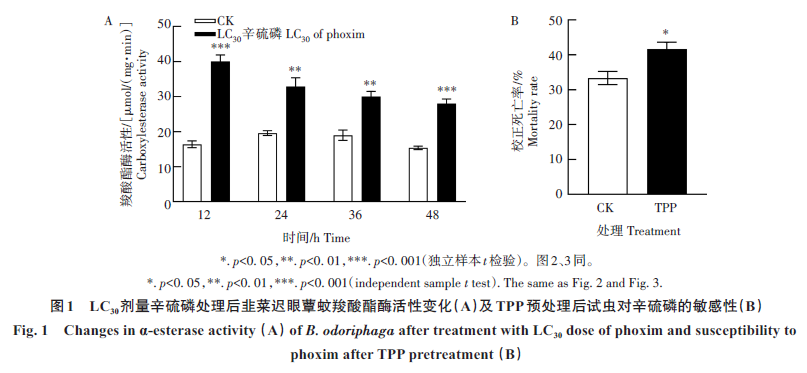
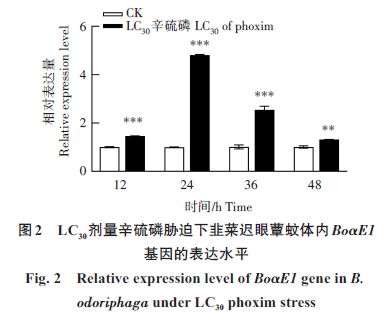
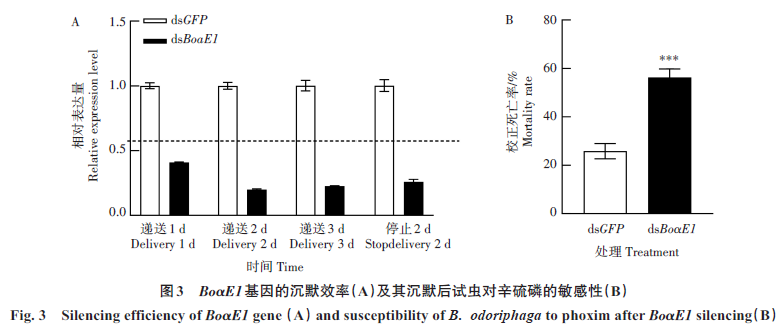
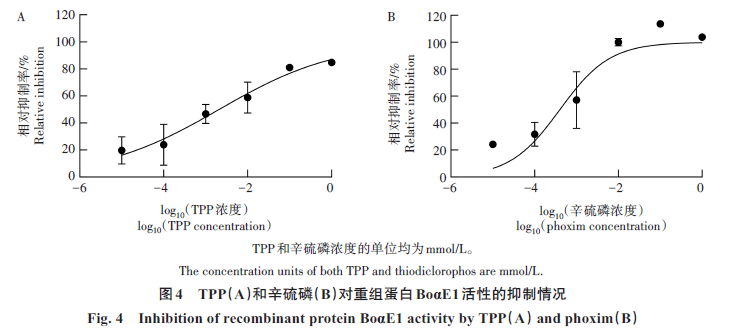
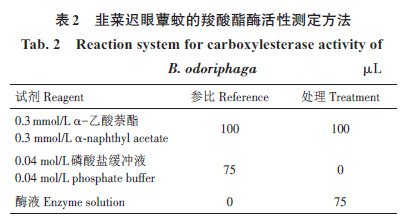
摘要: 韭菜迟眼蕈蚊是危害韭菜生产的主要害虫,已对常用有机磷杀虫剂辛硫磷产生抗性。为阐明韭菜迟眼蕈蚊对辛硫磷的解毒机制,采用酯酶特异性抑制剂增效试验、实时荧光定量PCR、RNA 干扰(RNAi)和体外抑制试验等方法进行分析。结果表明,在30%致死浓度(LC30)剂量辛硫磷胁迫下,3龄试虫体内的羧酸酯酶活性显著升高,处理12、24、36、48 h的羧酸酯酶活性分别为40.03、32.91、30.03、27.98 μmol/(mg·min),是空白对照的2.44倍、1.68倍、1.58倍和1.82倍;经特异性酯酶抑制剂磷酸三苯酯(TPP)处理后,试虫的校正死亡率为41.67%,较未饲喂TPP的对照试虫提升8.34百分点(相对提升25.0%);辛硫磷胁迫下羧酸酯酶基因BoαE1 表达量显著上升,沉默该基因后试虫的校正死亡率达56.25%,较未经受RNAi处理的对照试虫提高30.44百分点(相对提升117.9%);体外抑制试验结果显示,辛硫磷对重组蛋白BoαE1的抑制中浓度(IC₅₀)为4.020×10⁻⁴ mg/L。综上,羧酸酯酶基因BoαE1参与韭菜迟眼蕈蚊对辛硫磷的解毒代谢,在有机磷杀虫剂抗性形成中发挥重要作用。

关键词: 韭菜迟眼蕈蚊, 辛硫磷, 羧酸酯酶, RNA干扰, 解毒代谢

Abstract: Bradysia odoriphaga is a major pest of Chinese chive and has developed resistance to the commonly used organophosphorus insecticide phoxim.To elucidate the detoxification mechanism of B.odoriphaga against phoxim,a combination of methods including carboxylesterase‐specific inhibitor synergism assay,quantitative real‐time PCR,RNA interference(RNAi),and in vitro inhibition assay were employed.The results showed that under exposure to the 30% lethal concentration(LC30)of phoxim,carboxylesterase activity in third‐instar larvae increased significantly.The carboxylesterase activities at 12,24,36,and 48 h post‐treatment were 40.03,32.91,30.03,and 27.98 μmol/(mg·min),representing 2.44‐,1.68‐,1.58‐,and 1.82‐fold increases compared to the blank control.Following treatment with the specific carboxylesterase inhibitor triphenyl phosphate(TPP),the mortality of the larvae reached 41.67%,which was 8.34 percentage points higher(a relative increase of 25.0%)than the control group not fed with TPP.Under phoxim stress,the expression level of the carboxylesterase gene BoαE1 was significantly up‐regulated. Knockdown of BoαE1 by RNAi resulted in a corrected mortality rate of 56.25%,representing a 30.44 percentage point increase(a relative increase of 117.9%)compared to the control larvae without gene silencing.In vitro inhibition assays further demonstrated that phoxim inhibited the activity of the recombinant BoαE1 protein with a half‐maximal inhibitory concentration(IC50)of 4.020×10⁻⁴ mg/L. In conclusion,the carboxylesterase gene BoαE1 is involved in
the detoxification metabolism of phoxim in B.odoriphaga and plays a crucial role in the development of resistance to organophosphorus insecticides.

Key words: Bradysia odoriphaga, Phoxim, Carboxylesterase, RNAi, Detoxification metabolism

中图分类号: