河南农业科学 ›› 2026, Vol. 55 ›› Issue (8): 73-83.DOI: 10.15933/j.cnki.1004-3268.2026.08.008

• 农业资源与环境 • 上一篇    下一篇

缓释肥配施生物有机肥对甜叶菊生长及产量品质的影响

雷永琦,唐赫艺,王戈,武英霞,徐新娟   

  1. (河南科技学院 农学院,河南 新乡 453003)
  • 收稿日期:2025-11-26 接受日期:2026-01-15 出版日期:2026-08-15 发布日期:2026-08-25
  • 通讯作者: 徐新娟,副教授,博士,主要从事作物栽培生理生态研究。E-mail:xinjuan_xu@163.com
  • 作者简介:雷永琦,在读硕士研究生,研究方向:甜叶菊栽培生理。E-mail:18937929503@163.com
  • 基金资助:
    河南省科技攻关项目(242102111082);河南科技学院自然科学基础研究计划项目(2023NX001)

Effects of Combined Application of Slow‐Release Fertilizer and Bio‐organic Fertilizer on the Growth,Yield and Quality of Stevia rebaudiana

Lei Yongqi,Tang Heyi,Wang Ge,Wu Yingxia,Xu Xinjuan   

  1. (School of Agriculture,Henan Institute of Science and Technology,Xinxiang 453003,China)
  • Received:2025-11-26 Accepted:2026-01-15 Published:2026-08-15 Online:2026-08-25

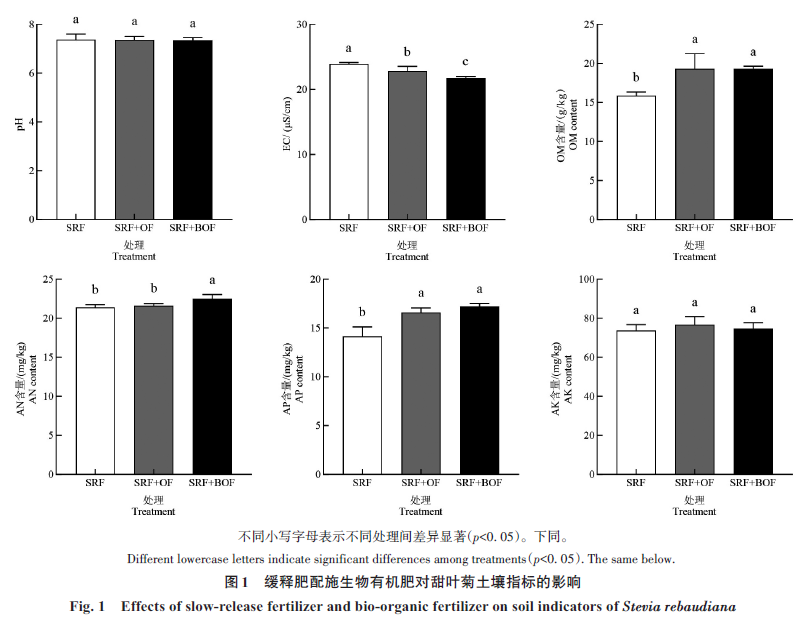
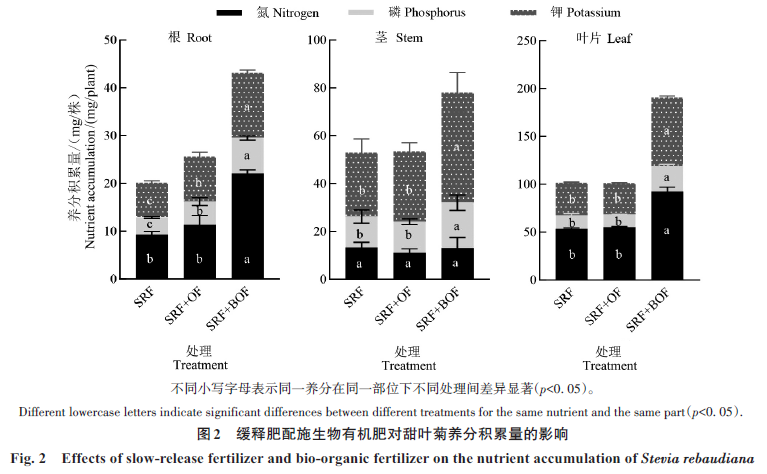
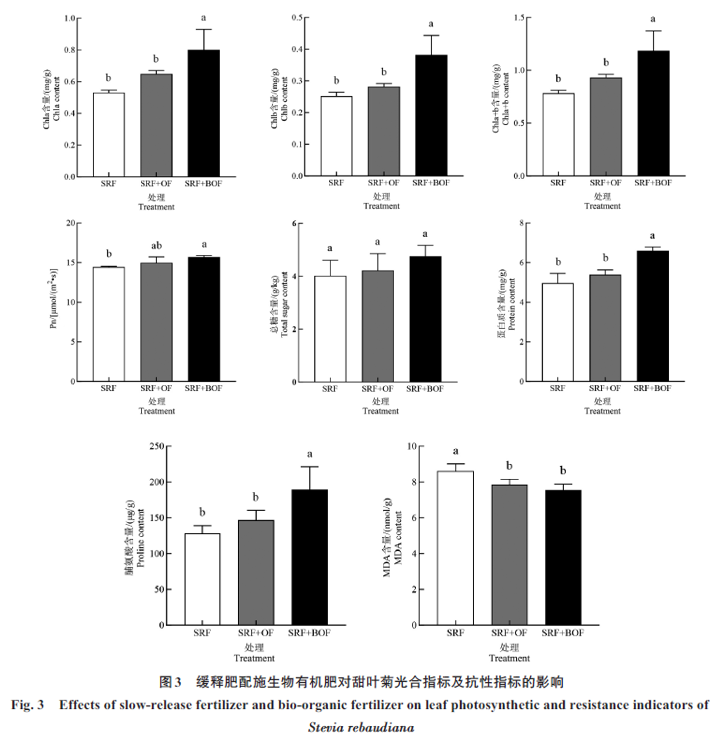
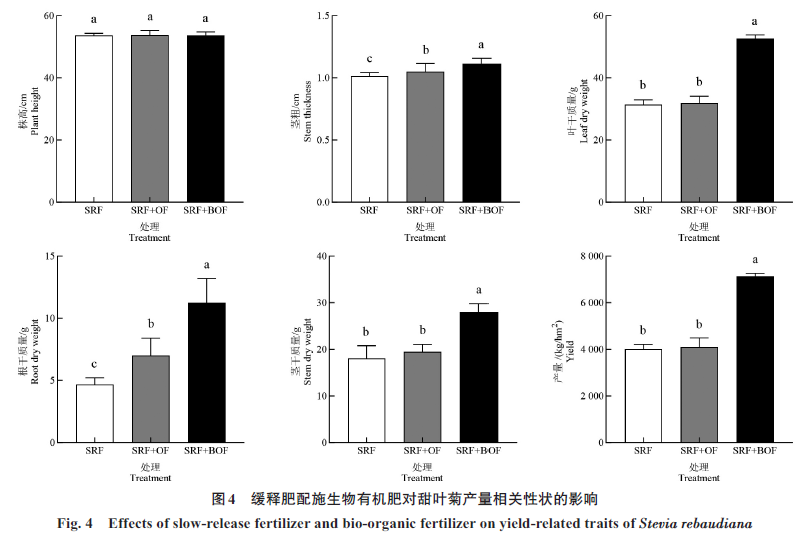
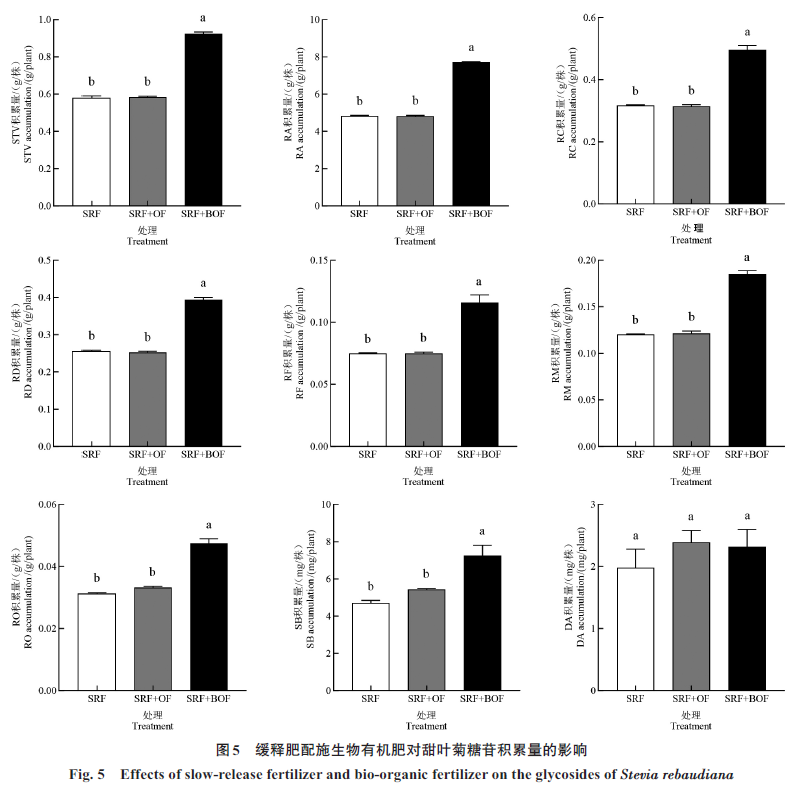
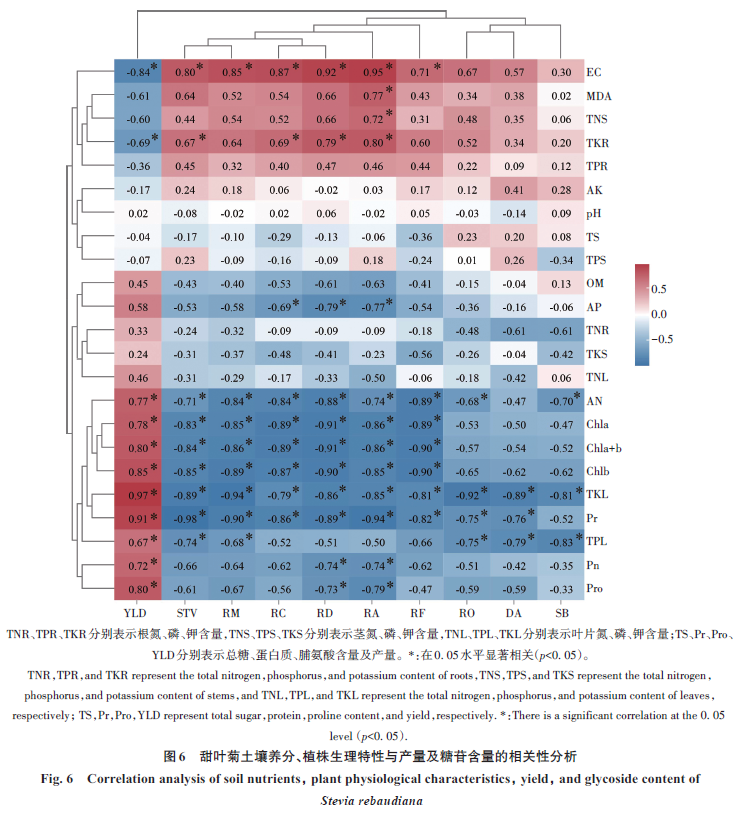
摘要: 为明确缓释肥配施生物有机肥的协同改良机制,探索甜叶菊绿色高效施肥模式,以单施缓释肥为对照(CK),在等量缓释肥基础上分别配施普通有机肥(OF)、生物有机肥(BOF),系统探究其对甜叶菊土壤理化性状、单株养分积累、光合生理、抗逆特性及产量、叶片糖苷含量的影响。结果表明,配施普通有机肥或生物有机肥对土壤pH值影响均不显著,但却显著降低土壤电导率(EC)值,其中配施生物有机肥的EC值最低,比对照降低了9.19%;土壤有机质、碱解氮和速效磷含量均为配施生物有机肥最大,比对照分别增加了21.59%、5.38%和21.57%。配施生物有机肥的单株养分积累量最大,其中叶片氮、磷、钾积累量分别比对照增加了73.21%、84.24%、110.87%。配施生物有机肥显著提高了叶片叶绿素a+b含量、净光合速率、蛋白质含量和脯氨酸含量,分别比对照增加了51.02%、8.69%、32.76%和47.33%;显著降低了叶片丙二醛含量,比对照降低了12.30%。该处理的根、茎、叶片干质量及产量也显著提高,其中产量比对照显著增加了77.48%。除杜克苷(DA)外,叶片糖苷积累量也以配施生物有机肥处理最高,主要糖苷组分甜菊苷(STV)和瑞鲍迪苷A(RA)分别比对照增加了59.41%、59.55%。相关分析结果显示,产量与土壤EC值、根钾(TKR)含量显著负相关,与土壤碱解氮(AN)含量及叶片磷(TPL)含量、钾(TKL)含量、叶绿素(a、b、a+b)含量、净光合速率(Pn)、蛋白质(Pr)含量、脯氨酸(Pro)含量显著正相关;所有糖苷组分均与叶片钾(TKL)含量显著负相关。综上,缓释肥配施生物有机肥可以改善土壤养分状况,促进植株光合作用与抗逆能力,进而提高甜叶菊产量及糖苷积累量。

关键词: 甜叶菊, 生物有机肥, 土壤理化性质, 生长, 糖苷积累

Abstract: To clarify the synergistic improvement mechanism of slow‐release fertilizer combined with bio‐organic fertilizer and explore the green and efficient fertilization mode of Stevia rebaudiana,single slow‐release fertilizer was used as the control(CK),and ordinary organic fertilizer(OF)and bio‐organic fertilizer(BOF)were separately applied on the basis of equal amount of slow‐release fertilizer. The effects of combined application of slow‐release fertilizer and fertilizer on soil physicochemical properties,individual plant nutrient accumulation,photosynthetic physiology,stress resistance characteristics,yield,and steviol glycoside content of Stevia rebaudiana were systematically investigated.The results showed that the application of ordinary organic fertilizer or bio‐organic fertilizer had no significant effect on soil pH value,but significantly reduced soil electrical conductivity(EC)value. Among them,the application of bio‐organic fertilizer had the lowest EC value,which was 9.19% lower than the control.The contents of soil organic matter,alkali‐hydrolyzable nitrogen,and available phosphorus were the highest when combined with bio‐organic fertilizer,increasing by 21.59%,5.38%,and 21.57% respectively compared to the control. The single plant with the application of bio‐organic fertilizer had the highest nutrient accumulation,with leaf nitrogen,phosphorus,and potassium accumulation increasing by 73.21%,84.24%,and 110.87% respectively compared to the control.The application of bio‐organic fertilizer significantly increased leaf chlorophyll a+b content,net photosynthetic rate,protein content,and proline content by 51.02%,8.69%,32.76%,and 47.33%,respectively compared to the control.It significantly reduced the content of malondialdehyde in the leaves,which was 12.30% lower than the control.Combined application of bio‐organic fertilizer significantly increased the dry weights of roots,stems,leaves and yield of Stevia rebaudiana,with a 77.48% increase in yield compared to the control. Except dulcoside(DA),the accumulation of leaf glycosides was also highest in the treatment with combined application of bio‐organic fertilizer.The main glycoside components,stevioside(STV)and rebaudioside A(RA),increased by 59.41% and 59.55% respectively compared to the control. The correlation analysis results showed that yield was significantly negatively correlated with soil EC value and total potassium content of roots(TKR),and significantly positively correlated with soil alkaline‐nitrogen(AN)content,leaf phosphorus(TPL)content,potassium(TKL)content,chlorophyll(a,b,a+b)content,net photosynthetic rate(Pn),protein(Pr)content,and proline(Pro)content;all glycoside components were significantly negatively correlated with total potassium content in leaves(TKL). In summary,the combination of slow‐release fertilizer and bio‐organic fertilizer can improve soil nutrient status,promote plant photosynthesis and stress resistance,thereby increasing the yield and glycosidic accumulation of Stevia rebaudiana.

Key words: Stevia rebaudiana L., Bio‐organic fertilizer, Soil physicochemical property, Growth, Glycoside accumulation

中图分类号: