河南农业科学 ›› 2026, Vol. 55 ›› Issue (5): 22-34.DOI: 10.15933/j.cnki.1004-3268.2026.05.003

• 玉米栽培专题 • 上一篇    下一篇

施氮方式和施氮量对花后高温胁迫下玉米光合、抗氧化特性和产量的影响

闫丽丽1,洪尧2,梁桂丽3   

  1. (1.河北省沧州市农业技术推广站,河北 沧州 061001;2.河北农业大学 农学院/华北作物改良与调控国家重点实验室,河北 保定 071000;3.沧州市农林科学院/河北省旱碱麦重点实验室,河北 沧州 061001)
  • 收稿日期:2025-11-05 接受日期:2025-12-25 出版日期:2026-05-15 发布日期:2026-06-01
  • 作者简介:闫丽丽,高级农艺师,本科,主要从事旱作农业种植研究。E-mail:x8t818@163.com
  • 基金资助:
    国家自然科学基金(32071936)

Effects of Nitrogen Application Method and Rate on Photosynthetic Characters,Antioxidant Properties,and Yield of Maize under High Temperature Stress after Flowering

YAN Lili1,HONG Yao2,LIANG Guili3   

  1. (1.Agricultural Technology Promotion Station of Cangzhou City,Hebei Province,Cangzhou 061001,China;2.College of Agronomy,Hebei Agricultural University/State Key Laboratory of North China Crop Improvement and Regulation,Baoding 071000,China;3.Cangzhou Academy of Agricultural and Forestry Sciences/Hebei Key Laboratory of Dryland Wheat,Cangzhou 061001,China)
  • Received:2025-11-05 Accepted:2025-12-25 Published:2026-05-15 Online:2026-06-01

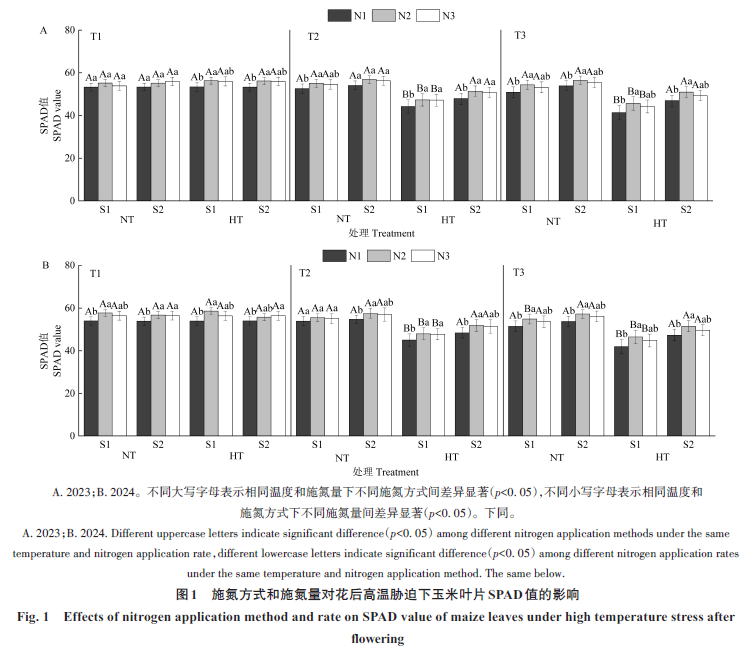
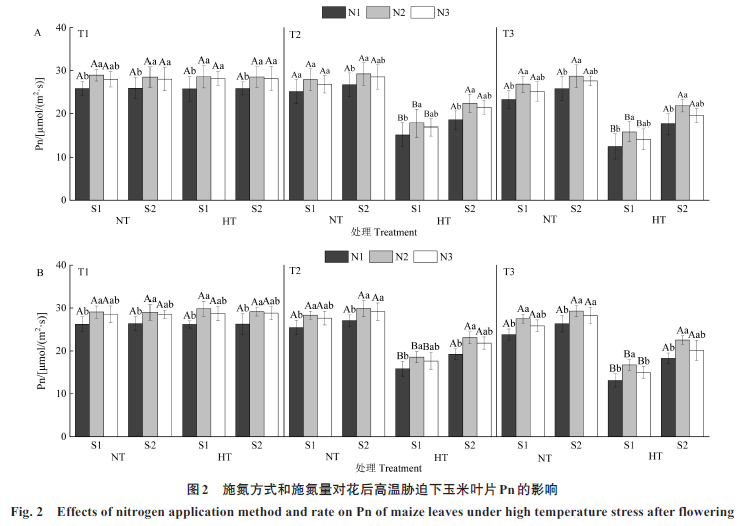
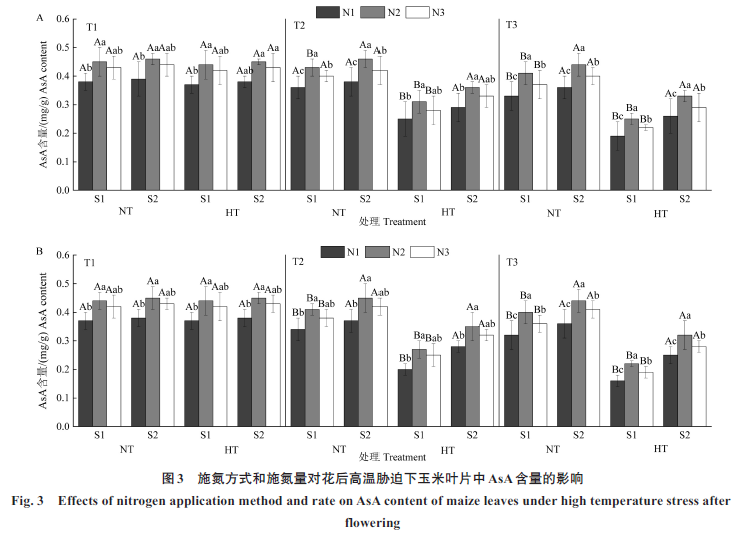
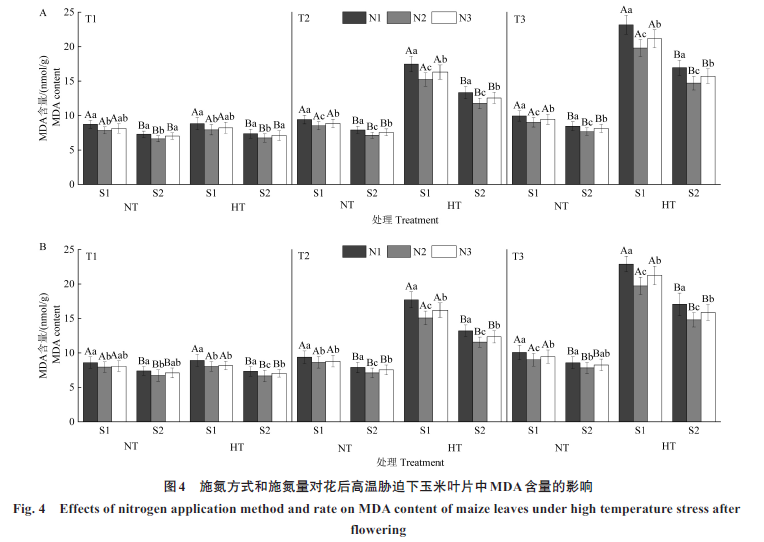
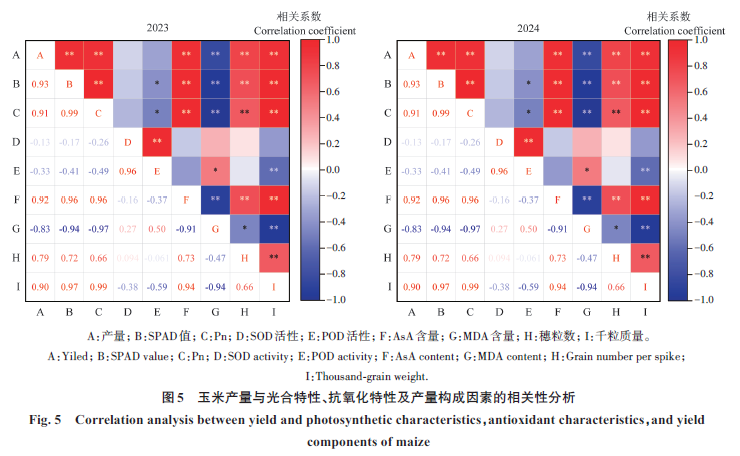
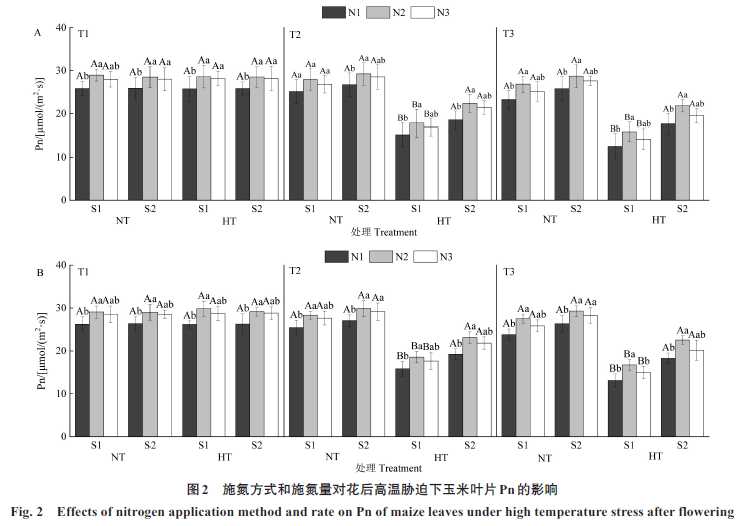
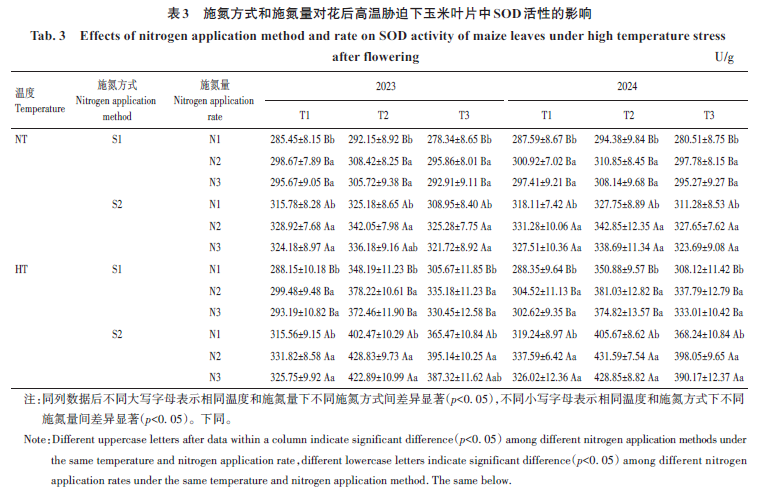
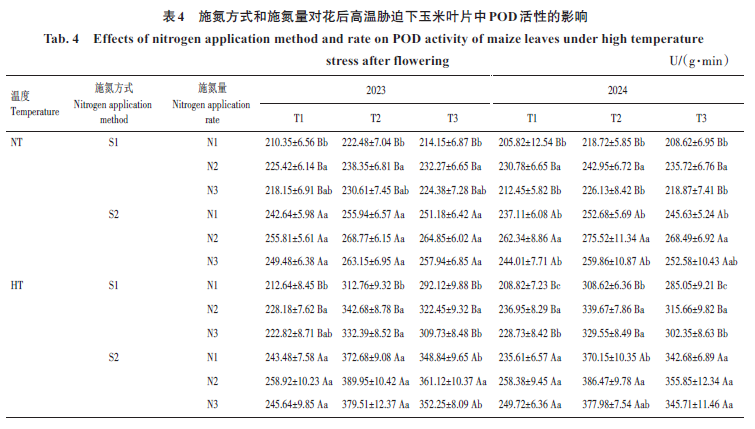
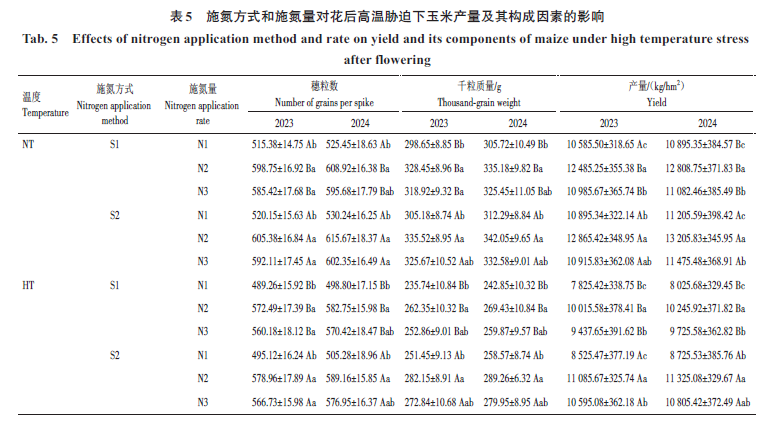
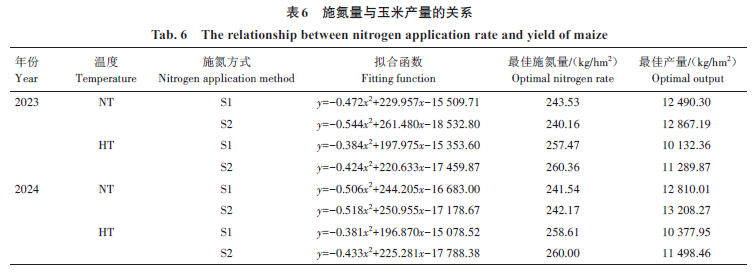
摘要: 于2023—2024年连续2 a开展大田试验,研究自然温度(NT)、花后高温(HT)下施氮方式[分次根施(S1)、根叶协同(S2)]和施氮量[180 kg/hm²(N1)、240 kg/hm²(N2)和300 kg/hm²(N3)]对玉米光合、抗氧化特性和产量的影响,以期筛选出适宜华北旱作区玉米耐高温的氮肥管理模式。结果表明,花后高温胁迫下,2 a玉米叶片SPAD值、净光合速率(Pn)、抗坏血酸(AsA)含量均降低,超氧化物歧化酶(SOD)活性、过氧化物酶(POD)活性、丙二醛(MDA)含量均提高,穗粒数和千粒质量均降低,进而产量均降低。不同施氮方式间比较,2 a S2处理SPAD值、Pn、ASA含量、SOD活性、POD活性、穗粒数、千粒质量、产量均显著高于S1处理,MDA含量均显著低于S1处理,其中HT下产量分别提高10.73%和10.21%。不同施氮量间比较,2 a N2和N3处理SPAD值、Pn、ASA含量、SOD活性、POD活性、穗粒数、千粒质量、产量均高于N1处理,MDA含量均低于N1处理,N2处理均达到显著水平,其中HT下N2处理产量分别较N1处理显著提高29.05%、28.77%。施氮量与产量线性拟合发现,NT下理论最佳施氮量为240.16~243.53 kg/hm²,HT下增加为257.47~260.36 kg/hm²,总体上S2处理的最佳施氮量均高于S1处理,且S2处理理论最佳产量均高于S1处理。相关性分析发现,HT下产量与SPAD值、Pn、AsA含量、穗粒数和千粒质量均呈极显著正相关,与MDA含量呈极显著负相关。综上,建议在华北旱作区玉米推广根叶协同施氮方式,自然温度年份施氮量为240 kg/hm²,花后高温年份适当增加施氮量至260 kg/hm²,以有效缓解高温胁迫,实现玉米高产稳产。

关键词: 玉米, 施氮方式, 施氮量, 花后高温胁迫, 光合特性, 抗氧化特性, 产量

Abstract: From 2023 to 2024,a field experiment was conducted for two consecutive years to study the effects of nitrogen application methods[split root application(S1),root‐leaf coordination(S2))]and nitrogen application rates[180 kg/ha(N1),240 kg/h(N2),and 300 kg/ha(N3)]on the photosynthetic characters,antioxidant properties and yield of maize under natural temperature(NT)and post‐flowering high temperature(HT) conditions. The aim was to select high‐temperature‐tolerant nitrogen fertilizer management mode in dryland farming area of North China. The results showed that under post‐flowering high temperature stress,the leaves SPAD values,net photosynthetic rate(Pn),and ascorbic acid(AsA)content of maize all decreased,while the activities of superoxide dismutase(SOD),peroxidase(POD),and malondialdehyde(MDA)content all increased,and the grains number per ear and 1 000‐grain weight all decreased,resulting in a decrease of yield. Comparisons among different nitrogen application methods showed that,the SPAD value,Pn,AsA content,SOD activity,POD activity,grains number per ear,1 000‐grain weight,and yield of S2 treatment were significantly higher than those of S1 treatment,and MDA content was significantly lower than that of S1 treatment in 2 a,among which the yield increased by 10.73% and 10.21% under HT,respectively.Comparisons among different nitrogen application rates showed that,the SPAD values,Pn,AsA contents,SOD activities,POD activities,grains number per ear,1 000‐grain weight,and yields of N2 and N3 treatments were higher than those of N1 treatment,and MDA contents were lower than that of N1 treatment in 2 a.The N2 treatment reached a significant level.Among them,the yields of N2 treatment significantly increased by 29.05% and 28.77% compared with N1 treatment under HT,respectively.The linear fitting of nitrogen application rate and yield showed that the theoretical optimal nitrogen application rate was 240.16—243.53 kg/ha under NT,and 257.47—260.36 kg/ha under HT.Overall,the optimal nitrogen application rate of S2 treatment was higher than that of S1 treatment,and the theoretical optimal yield of S2 treatment was higher than that of S1 treatment. Correlation analysis revealed that under HT,yield was significantly positively correlated with SPAD value,Pn,AsA content,grains number per ear and 1 000‐grain weight,and significantly negatively correlated with MDA content. In conclusion,it is recommended to promote the nitrogen application method of root‐leaf coordination in the dryland farming area of North China. Nitrogen application amount of 240 kg/ha should be adopted under natural temperature years,and 260 kg/ha under post‐flowering high temperature years to effectively alleviate high temperature stress and achieve high and stable yield of maize.

Key words: Maize, Nitrogen application method, Nitrogen application rate, High temperature stress after flowering, Photosynthetic characteristics, Antioxidant properties, Yield

中图分类号: