河南农业科学 ›› 2026, Vol. 55 ›› Issue (4): 90-99.DOI: 10.15933/j.cnki.1004-3268.2026.04.009
李明哲1,毛雨晴2,杨洁琼2,郭润霞2,段振伟2,班立桐1,王远宏1,于海利2
收稿日期:2025-07-25
接受日期:2025-09-12
出版日期:2026-04-15
发布日期:2026-05-07
通讯作者:
王远宏,教授,博士,主要从事植物病害防治和生防微生物分子生物学研究。E-mail:Wangyh@tjau.edu.cn
于海利,副研究员,博士,主要从事植物保护、食用菌栽培研究。E-mail:yhl860310@163.com
作者简介:李明哲,在读硕士研究生,研究方向:植物病理学。E-mail:743179970@qq.com
基金资助:LI Mingzhe1,MAO Yuqing2,YANG Jieqiong2,GUO Runxia2,DUAN Zhenwei2,BAN Litong1,WANG Yuanhong1,YU Haili2
Received:2025-07-25
Accepted:2025-09-12
Published:2026-04-15
Online:2026-05-07
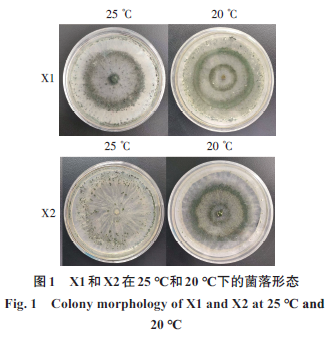
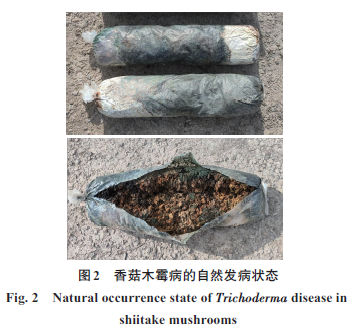
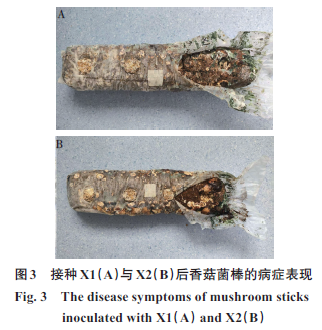
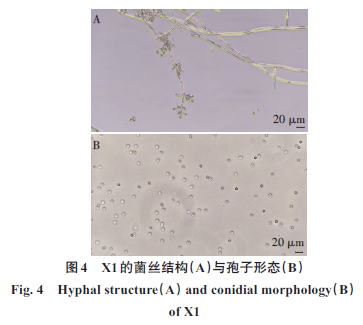
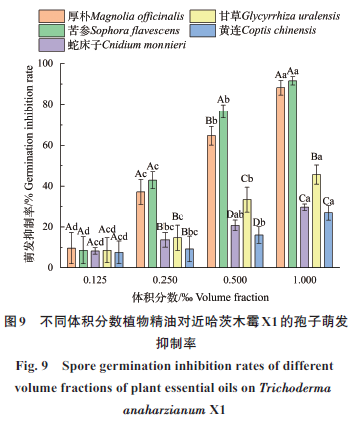
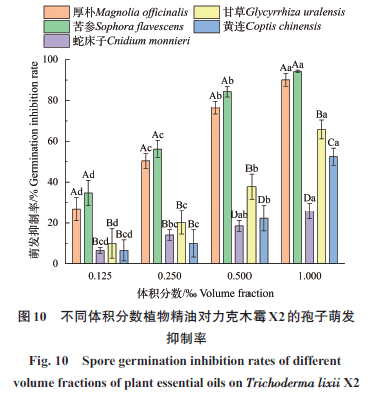
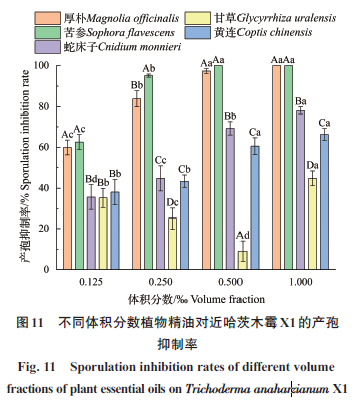
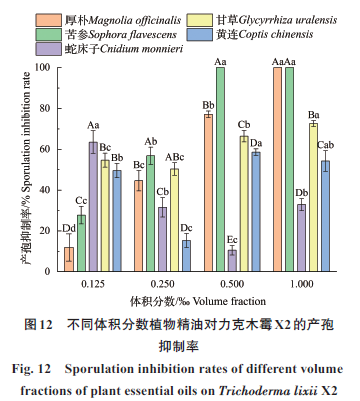
摘要: 木霉病害是制约西北地区香菇产业发展的主要生物胁迫因素之一,为明确其病原菌种类,探寻有效的生物防治手段,对甘肃省武威市香菇大棚内染病菌棒的致病木霉进行了分离、形态学观察和分子鉴定,并综合测评了5种植物(厚朴、苦参、蛇床子、甘草和黄连)精油在不同体积分数下(0、0.125‰、0.250‰、0.500‰、1.000‰)对病原菌的防治效果。结果表明,造成香菇菌棒大规模污染的主要致病木霉为近哈茨木霉(Trichoderma anaharzianum)和力克木霉(Trichoderma lixii)。苦参精油对2种致病菌的抑菌效果最佳,当体积分数为1.000‰时,2种木霉的菌丝生长和孢子产量均受到完全抑制,孢子萌发抑制率分别为93.73% 和97.17%。此外,厚朴精油对2 种致病菌也具有较强的抑菌效果,当体积分数为1.000‰时抑制效果达到最佳,2种木霉的菌丝生长抑制率分别为94.91%和94.01%,孢子萌发抑制率分别为90.24%和92.93%,孢子产量均受到完全抑制。其他3种精油对2种木霉菌丝生长的抑制率较低,但在孢子萌发和孢子产量方面有不同的抑制效果。综上,苦参与厚朴精油在香菇木霉病菌菌丝生长、孢子萌发、孢子产量三方面的综合抑制效果最佳,可作为植物源抑菌剂用于香菇木霉病害的绿色防治。
中图分类号:
李明哲, 毛雨晴, 杨洁琼, 郭润霞, 段振伟, 班立桐, 王远宏, 于海利. 香菇主要木霉病原菌的分离鉴定及5 种植物精油抑菌效果研究[J]. 河南农业科学, 2026, 55(4): 90-99.
LI Mingzhe, MAO Yuqing, YANG Jieqiong, GUO Runxia, DUAN Zhenwei, BAN Litong, WANG Yuanhong, YU Haili. Isolation and Identification of the Main Trichoderma Pathogens in Shiitake Mushrooms and Study on the Antibacterial Effects of Five Plant Essential Oils[J]. Journal of Henan Agricultural Sciences, 2026, 55(4): 90-99.
| [1]曹斌. 新时代背景下中国香菇消费市场发展特征与趋势[J]. 食用菌学报,2023,30(3):90‑102. CAO B.Characteristics and trend of shiitake mushroom consumption market in China in the new era[J]. Acta Edulis Fungi,2023,30(3):90‑102. [2]CHEN H L,JU Y,LI J J,et al. Antioxidant activities of polysaccharides from Lentinus edodes and their significance for disease prevention[J]. International Journal of Biological Macromolecules,2012,50(1):214‑218. [3]RANGEL‑VARGAS E,RODRIGUEZ J A,DOMÍNGUEZ R,et al. Edible mushrooms as a natural source of food ingredient/additive replacer[J]. Foods,2021,10(11):2687. [4]LI C T,XU S. Edible mushroom industry in China:Current state and perspectives[J]. Applied Microbiology and Biotechnology,2022,106(11):3949‑3955. [5]曹斌,张月吟,高博. 全球香菇产业发展历史、现状及趋势[J]. 食用菌学报,2024,31(3):1‑20. CAO B,ZHANG Y Y,GAO B. Development history,current situation and trends of global Lentinula edodes industry[J]. Acta Edulis Fungi,2024,31(3):1‑20.[6]张树庚,王玉忠,院海英,等. 武威市凉州区食用菌产业发展现状分析及对策[J]. 甘肃科技,2023,39(9):1‑3. ZHANG S G,WANG Y Z,YUAN H Y,et al. Analysis on the development status of edible fungi industry in Liangzhou district of Wuwei City and countermeasures[J]. Gansu Science and Technology,2023,39(9):1‑3. [7]冀瑞卿,程国辉,安小亚,等. 四种杀菌剂对食用菌竞争性杂菌及其食用菌菌丝生长的影响[J]. 北方园艺,2014(20):133‑137. JI R Q,CHENG G H,AN X Y,et al. Effect of four fungicides on the competitive bacterial edible fungus of mushroom and mushroom mycelial growth[J]. Northern Horticulture,2014(20):133‑137.[8]张宏浩,王亚磊,冀瑞卿. 几种食用菌的抗病性分析[J]. 北方园艺,2015(17):127‑129. ZHANG H H,WANG Y L,JI R Q. Analysis the inhibiting effect of edible mushrooms[J]. Northern Horticulture,2015(17):127‑129.[9]曹子健. 污染香菇基质木霉的精准鉴定及其检测技术研究[D]. 邯郸:河北工程大学,2023. CAO Z J. Study on accurate identification and detection technology of Trichoderma spp.contaminated Lentinula edodes substrate[D]. Handan:Hebei University of Engineering,2023.[10]李丰硕,冀宝营,韩冰,等. 香菇与木霉互作方式及绿霉病防治研究进展[J]. 食用菌学报,2024,31(3):113‑124. LI F S,JI B Y,HAN B,et al. Research progress in interaction between Lentinula edodes and Trichoderma spp.,and the control of green mold disease[J]. Acta Edulis Fungi,2024,31(3):113‑124.[11]罗秀俊,郭建峰,韩波波,等. 一株香菇病原真菌的分离、鉴定与室内防治药剂筛选[J]. 云南农业大学学报(自然科学),2017,32(5):793‑804. LUO X J,GUO J F,HAN B B,et al. Isolation,identification of a Lentinula edodes pathogen and vitro screening of control medicament[J]. Journal of Yunnan Agricultural University,2017,32(5):793‑804. [12]王喜刚,徐瑾瑜,田静,等. 宁夏三种食用菌常见病虫害种类及防治措施[J]. 黑龙江农业科学,2025(4):122‑126. WANG X G,XU J Y,TIAN J,et al. Common pests and diseases species and control measures for three edible fungi in Ningxia [J]. Heilongjiang Agricultural Sciences,2025(4):122‑126.[13]边银丙,肖扬,郭孟配. 食用菌病害防控研究进展[J]. 食用菌学报,2021,28(5):121‑131. BIAN Y B,XIAO Y,GUO M P. Research progress on disease control of edible fung[i J]. Acta Edulis Fungi,2021,28(5):121‑131.[14]王刚正,曹现涛,边银丙. 36种植物提取物液对食用菌两种竞争性木霉菌的抑制作用[J]. 中国食用菌,2015,34(2):74‑76. WANG G Z,CAO X T,BIAN Y B. Antimicrobial effect of plant extracts from 36 species against competitive Trichoderma viride and T.oblongisporum from edible mushroom cultivation[J]. Edible Fungi of China,2015,34(2):74‑76. [15]刘婷婷,付旭娟,黄梅,等. 榆黄蘑木霉病病原菌分离鉴定及植物源抑菌剂筛选[J]. 南方农业学报,2024,55(12):3603‑3614. LIU T T,FU X J,HUANG M,et al. Isolation and identification of pathogen of Trichoderma disease in Pleurotus citrinipileatus and screening of plant bacteriostatic agents [J]. Journal of Southern Agriculture,2024,55(12):3603‑3614. [16]姜萍,叶汉玲,安鑫南. 苦楝提取物的提取及其抑菌活性的研究[J]. 林产化学与工业,2004,24(4):23‑27. JIANG P,YE H L,AN X N. Studies on extraction of extractives from Melia azedarach L. and its bacteriostatic activity[J]. Chemistry and Industry of Forest Products,2004,24(4):23‑27. [17]程秋芋,谢丽红,易萍,等. 植物精油对火龙果采后病原菌的抑制效果[J]. 南方农业学报,2026,57(2):511‑519. CHENG Q Y,XIE L H,YI P,et al. Inhibitory effect of plant essential oils on postharvest pathogens in pitaya[J]. Journal of Southern Agriculture,2026,57(2):511‑519. [18]杨康,张可,吴阔,等. 3种植物精油主要成分及其对烟草疫霉的抑菌活性[J]. 南方农业学报,2025,56(10):3208‑3219. YANG K,ZHANG K,WU K,et al. Main components of three plant essential oils and their antimicrobial activity on Phytophthora nicotianae[J]. Journal of Southern Agriculture,2025,56(10):3208‑3219.[19]兰善玉,邹宇宁,徐淼,等. 中药活性成分抗皮肤癣菌的最新研究进展[J]. 中国真菌学杂志,2025,20(1):98‑103. LAN S Y,ZOU Y N,XU M,et al. The latest research progress of the active ingredients of traditional Chinese medicine against Dermatophyton[J]. Chinese Journal of Mycology,2025,20(1):98‑103.[20]ALJAAFARI M N,ALALI A O,BAQAIS L,et al. An overview of the potential therapeutic applications of essential oils[J]. Molecules,2021,26(3):628. [21] 高永生,金斐,朱丽云,等. 植物精油及其活性成分的抗菌机理[J]. 中国食品学报,2022,22(1):376‑388. GAO Y S,JIN F,ZHU L Y,et al. Antimicrobial mechanism of plant essential oils and its active ingredients[J].Journal of Chinese Institute of Food Science and Technology,2022,22(1):376‑388. [22]王安可,毕毓芳,王玉魁,等. 3种芳香植物精油对竹材防霉作用初探[J]. 竹子学报,2018,37(2):34‑42. WANG A K,BI Y F,WANG Y K,et al. Effects of three kind of plant essential oils on the mould‑resistance of bamboo[J]. Journal of Bamboo Research,2018,37(2):34‑42. [23]胡拉,杨章旗,秦理哲,等. 植物精油对木材霉变菌的抑菌效力研究[J]. 中南林业科技大学学报,2020,40(1):144‑149. HU L,YANG Z Q,QIN L Z,et al. Antifungal efficacy of plant essential oils against wood mould and stain fungi[J]. Journal of Central South University of Forestry & Technology,2020,40(1):144‑149.[24]令利军,程文婷,蒋坤玲,等. 黄花蒿精油及其单体桉叶油醇对兰州百合采后病害的防治效果[J]. 西北农林科技大学学报(自然科学版),2022,50(8):77‑87. LING L J,CHENG W T,JIANG K L,et al. Control of postharvest diseases of Lanzhou lily using essential oil of Artemisia annua L. and its monomer eucalyptol[J].Journal of Northwest A&F University(Natural Science Edition),2022,50(8):77‑87.[25]蒋世一,王喜明,王雅梅. 20种中草药水提液对白腐菌和褐腐菌的抑菌作用[J]. 木材加工机械,2014,25(5):33‑35. JIANG S Y,WANG X M,WANG Y M. Antifungal activities of 20 kinds of Chinese herbal extracts of water wood white‑rot fungi and wood brown‑rot fungi[J]. Wood Processing Machinery,2014,25(5):33‑35. [26]张莲朋,徐敏,杨建新,等. 三门峡烟株内生真菌分离及功能菌株筛选和鉴定[J]. 农药学学报,2025,27(3):513‑524. ZHANG L P,XU M,YANG J X,et al. Isolation of endophytic fungi from tobacco plants in Sanmenxia and screening and identification of functional strains[J]. Chinese Journal of Pesticide Science,2025,27(3):513‑524.
[27]柴秋源,张洁,李晓强,等. 植物寄生线虫生防菌株YB-366的种类鉴定及防效测定[J]. 河南农业科学,2025,54(6):92‑99.
[28]杜辰阳,沈凤英,吴俊伟,等. 八棱海棠腐烂病病原菌的分离鉴定、生物学特性研究及防治药剂筛选[J]. 河南农业科学,2025,54(3):99‑109.
[29]王丹,张静,贾晓曼,等. 丁香精油对甜樱桃采后优势致腐真菌的控制及其抑菌机理[J]. 核农学报,2020,34(6):1221‑1229.
[30]周小四,孙艳茹,高方园,等. 菊花枯萎病生防细菌SFB-1的分离、鉴定及其生防作用[J].江苏农业科学,2024,52(21):133‑143.
[31]王鹏,别赵薇,夏乐乐. 路易斯安那鸢尾叶部病害病原鉴定和防治药剂筛选[J]. 河南农业科学,2023,52(12):107‑115.
[32]胡棋兰,唐彩艳,袁娅娅,等. 烟草赤星病生防木霉的筛选鉴定及生防潜力分析[J/OL]. 南方农业学报,2025:1‑16(2025‑09‑12)[2025‑12‑05]. https://link.cnki.net/urlid/45.1381.S.20250912.1039.004. [33]ZHENG H,QIAO M,LV Y F,et al. New species of Trichoderma isolated as endophytes and saprobes from southwest China[J]. Journal of Fungi,2021,7(6):467.
[34]王科,杨祝良,赵长林,等. 中国菌物汉语学名拟定和使用现状及2021年中国新物种的拉丁-汉语学名名录[J]. 菌物研究,2023,21(1):42‑64.
JING M F,XIA Y Q,CHEN H,et al. Research progress on management techniques for crop Phytophthora diseases[J]. Plant Protection,2025,51(5):370‑379. |
| [1] | 韩昱, 孙天琦, 唐毓蔓, 徐林贵, 孙晓波, 王丽红, 隋春. 菘蓝根腐病病原鉴定及抗病种质筛选[J]. 河南农业科学, 2026, 55(3): 118-125. |
| [2] | 段然, 郭洁, 周晓华1, 张迪, 马莹, 吴绪金, 王铁良. 外源硒添加对香菇金属元素累积与食用安全性的影响[J]. 河南农业科学, 2025, 54(9): 171-180. |
| [3] | 杜辰阳, 沈凤英, 吴俊伟, 赵鑫蕊, 王雪, 吴伟刚. 八棱海棠腐烂病病原菌的分离鉴定、生物学特性研究及防治药剂筛选[J]. 河南农业科学, 2025, 54(3): 99-109. |
| [4] | 刘丽娜, 崔国梅, 李顺峰, 许方方, 田广瑞, 纪沐风, 魏书信, 王安建. 香菇菌糠中木质纤维素的挤压降解及结构表征[J]. 河南农业科学, 2024, 53(8): 173-180. |
| [5] | 叶志晖, 邵新光, 赵晓忠. 不同促生真菌菌肥配施对烤烟致香成分、感官质量及土壤性质的影响[J]. 河南农业科学, 2024, 53(6): 37-48. |
| [6] | 刘丽娜, 李顺峰, 许方方, 崔国梅, 高帅平, 王安建, 田广瑞, 魏书信. 不同生长期香菇培养料中木质纤维素的变化特征[J]. 河南农业科学, 2024, 53(3): 110-117. |
| [7] | 李海利, 张婉琪, 徐引弟, 王治方, 朱文豪, 闫祥洲, 冯丽丽, 杨帆, 马春江. 莫海威芽孢杆菌对革兰氏阳性菌的抑制活性及其抗菌次级代谢产物分析[J]. 河南农业科学, 2024, 53(12): 149-158. |
| [8] | 李海利, 徐引弟, 王治方, 朱文豪, 陈建豪, 李斌, 段进刚, 冯丽丽, 杨帆, 马春江, 闫祥洲. 胶冻样芽孢杆菌对革兰氏阴性菌的抑菌活性及其抗菌次级代谢产物分析[J]. 河南农业科学, 2024, 53(10): 159-169. |
| [9] | 魏书信, 王安建, 高帅平, 田广瑞, 刘丽娜, 许方方, 李顺峰, 崔国梅. 香菇培养料的双螺杆挤压灭菌工艺优化[J]. 河南农业科学, 2024, 53(1): 172-179. |
| [10] | 王鹏, 别赵薇, 夏乐乐. 路易斯安那鸢尾叶部病害病原鉴定和防治药剂筛选[J]. 河南农业科学, 2023, 52(12): 107-115. |
| [11] | 刘芹, 特日根, 师子文, 吴杰, 胡素娟, 崔筱, 孔维丽. 不同品种香菇子实体游离氨基酸组成的主成分分析及综合评价[J]. 河南农业科学, 2022, 51(7): 134-144. |
| [12] | 张亚玲, 唐雪婷, 王兵, 候钰煊, 赵羽涵, 靳学慧. 木霉菌与杀菌剂联合使用对水稻纹枯病菌的抑制效果[J]. 河南农业科学, 2021, 50(9): 96-104. |
| [13] | 李顺峰, 刘丽娜, 王安建, 田广瑞, 许方方, 魏书信. 香菇煮菇水5′-磷酸二酯酶酶解增鲜技术[J]. 河南农业科学, 2021, 50(2): 167-172. |
| [14] | 杨瑾, 文艺, 高素霞, 刘玉霞, 鲁传涛, 王飞, 刘红彦. 河南产区丹参根腐病病原鉴定[J]. 河南农业科学, 2021, 50(10): 92-98. |
| [15] | 王步云,乔 岩,张 涛,郑书恒,赵 磊,万 敏,李恒羽,王吐虹. 北京地区草莓炭疽病病原鉴定及生物防治药剂筛选[J]. 河南农业科学, 2019, 48(4): 88-92. |
| 阅读次数 | ||||||
|
全文 |
|
|||||
|
摘要 |
|
|||||