河南农业科学 ›› 2026, Vol. 55 ›› Issue (7): 20-30.DOI: 10.15933/j.cnki.1004-3268.2026.07.003

• 作物栽培·遗传育种 • 上一篇    下一篇

高浓度CO2 与镉胁迫下水稻幼苗根系淀粉-蔗糖代谢响应

刘瑷华,冯紫媛,温彩霞,刘文雍,马 琪,傅俐源,向兴节,王兰兰   

  1. (沈阳师范大学 生命科学学院,辽宁 沈阳 110034)
  • 收稿日期:2025-12-18 接受日期:2026-02-06 出版日期:2026-07-15 发布日期:2026-07-30
  • 通讯作者: 王兰兰,教授,博士,主要从事环境变化与植物生理生态研究。E-mail:wangqi5387402006@163.com
  • 作者简介:刘瑷华,在读硕士研究生,研究方向:环境变化与植物生理生态。E-mail:19995051521@163.com
  • 基金资助:
    辽宁省基本科研业务费支持项目-重大项目孵化工程专项(LJ202410166051)

Response of Starch⁃Sucrose Metabolism in Rice Seedling Roots to Elevated CO and Cadmium Stress

Liu Aihua,Feng Ziyuan,Wen Caixia,Liu Wenyong,Ma Qi,Fu Liyuan,Xiang Xingjie,Wang Lanlan   

  1. (College of Life Sciences,Shenyang Normal University,Shenyang 110034,China)
  • Received:2025-12-18 Accepted:2026-02-06 Published:2026-07-15 Online:2026-07-30

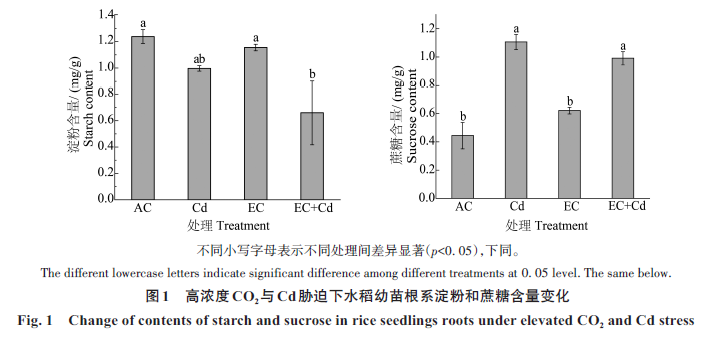
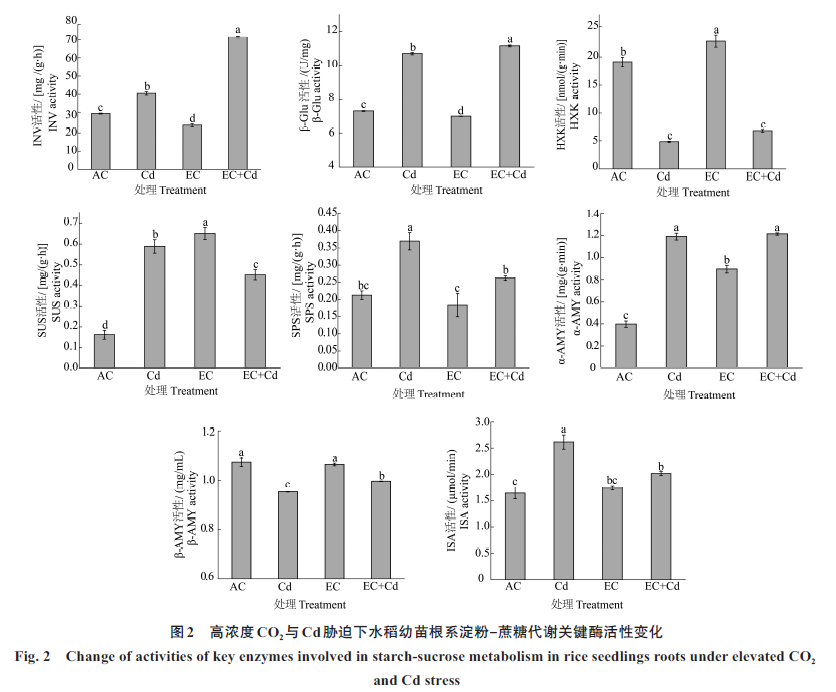
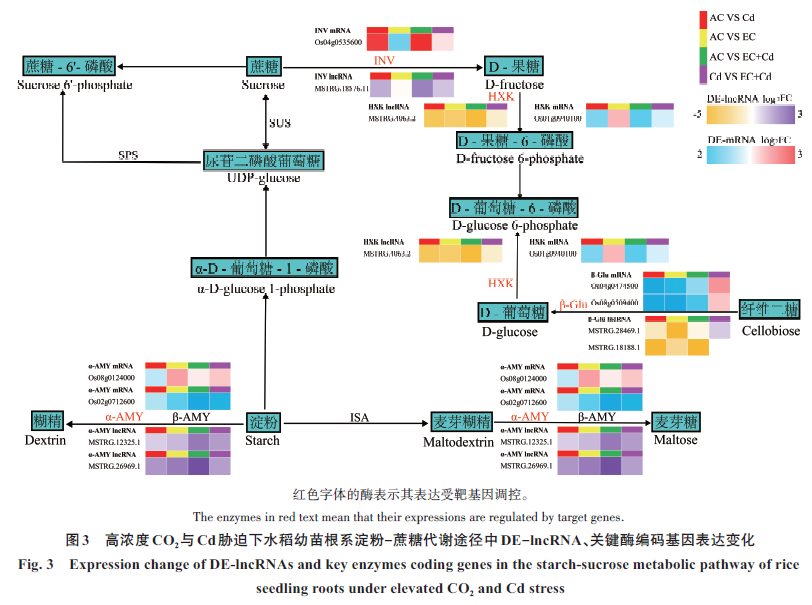
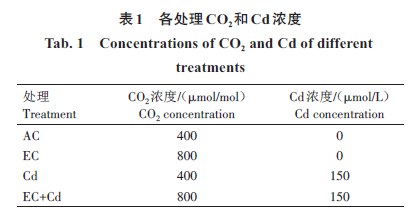
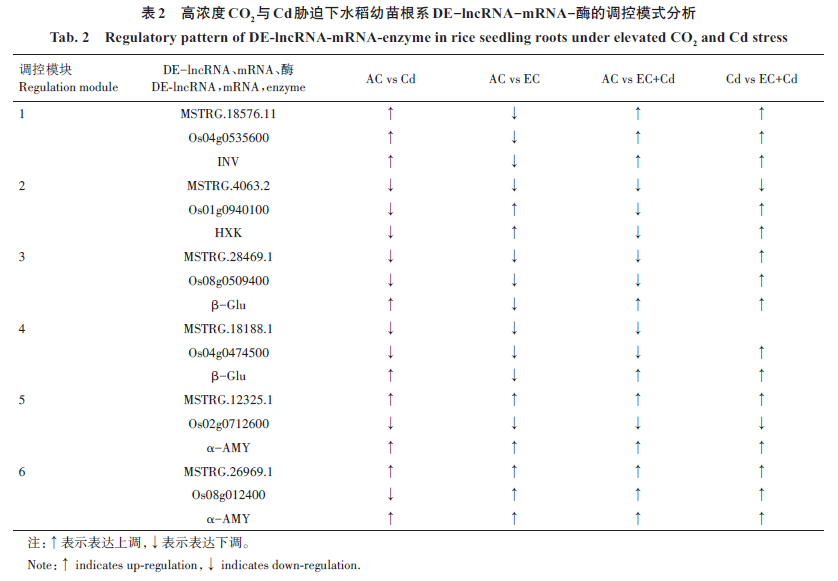
摘要: 为揭示高浓度CO2、镉(Cd)胁迫及其复合胁迫下水稻幼苗根系中淀粉-蔗糖代谢调控机制,设置对照(AC,400 μmol/mol CO2+0 μmol/L CdCl2)、Cd处理(Cd,400 μmol/mol CO2+150 μmol/L CdCl2)、高浓度CO2处理(EC,800 μmol/mol CO2+0 μmol/L CdCl2)、高浓度CO2+Cd 处理(EC+Cd,800 μmol/mol CO2+150 μmol/L CdCl2),研究不同处理下根系淀粉、蔗糖含量及关键代谢酶活性,筛选不同对比组中的差异表达长链非编码RNA(DE-lncRNA),并探寻DE-lncRNA的潜在顺式调控靶基因,将DE-lncRNA的潜在顺式调控靶基因与淀粉-蔗糖代谢通路中关键酶编码基因取交集,进行调控模式分析。结果表明,与AC处理比较,Cd处理降低水稻根系淀粉含量,显著提高蔗糖含量,显著增强蔗糖转化酶(INV)、β-葡萄糖苷酶(β-Glu)、蔗糖合成酶(SUS)、蔗糖磷酸合成酶(SPS)、α-淀粉酶(α-AMY)、异淀粉酶(ISA)活性,显著抑制己糖激酶(HXK)、β-淀粉酶(β-AMY)活性,促进淀粉降解和蔗糖累积;EC处理降低淀粉含量、升高蔗糖含量,但差异均不显著,显著降低INV、β-Glu活性,显著升高HXK、SUS及α-AMY活性;EC+Cd处理显著降低淀粉含量,显著提高蔗糖含量,显著提升INV、β-Glu、SUS、α-AMY及ISA活性,显著抑制HXK与β-AMY活性。与Cd处理比较,EC+Cd处理降低淀粉和蔗糖含量,但差异不显著,显著增强INV、β-Glu、β-AMY活性,显著抑制SUS、SPS、ISA活性。对不同对比组中的DE-lncRNA及其靶基因进行分析发现,与AC 处理相比,Cd 处理DE-lncRNA MSTRG.18576.11 表达上调并正调控靶基因INV(Os04g0535600),提高INV活性;MSTRG.4063.2与靶基因Os01g094010表达同步下调,降低HXK活性;MSTRG.28469.1、MSTRG.18188.1均表达下调且正调控靶基因(分别为Os08g0509400、Os04g0474500),提高β-Glu活性;MSTRG.12325.1、MSTRG.26969.1均表达上调且负调控靶基因(分别为Os02g0712600、Os08g012400),提高α-AMY活性。EC处理MSTRG.18576.11与靶基因表达同步下调,降低INV活性;MSTRG.4063.2表达下调且负调控靶基因,提高HXK活性;MSTRG.18188.1、MSTRG.28469.1均与靶基因表达同步下调,降低β-Glu活性;MSTRG.12325.1表达上调且负调控靶基因,MSTRG.26969.1表达上调且正调控靶基因,以MSTRG.26969.1正调控作用为主,提高α-AMY活性。EC+Cd处理MSTRG.18576.11与靶基因表达同步上调,提高INV 活性;MSTRG.4063.2 与靶基因表达同步下调,降低HXK 活性;MSTRG.28469.1、MSTRG.18188.1与靶基因表达均同步下调,提高β-Glu活性;MSTRG.12325.1表达上调并负调控靶基因,MSTRG.26969.1表达上调并正调控靶基因,以MSTRG.26969.1正调控效应为主,提高α-AMY活性。与Cd处理相比,EC+Cd处理MSTRG.18576.11表达上调并正调控靶基因,提高INV活性;MSTRG.4063.2表达下调且负调控靶基因,提高HXK活性;MSTRG.28469.1表达上调并正调控靶基因,促进β-Glu 活性升高,MSTRG.18188.1 表达无显著变化但仍可通过调控靶基因提高β-Glu 活性;MSTRG.12325.1表达上调并负调控靶基因,MSTRG.26969.1表达上调并正调控靶基因,使α-AMY活性保持稳定。

关键词: 水稻, 根系, 高浓度CO2, 镉胁迫, 淀粉-蔗糖代谢响应, 差异表达lncRNA

Abstract: In order to explore the regulatory mechanism of starch⁃sucrose metabolism in rice seedling roots under elevated CO₂(EC),cadmium(Cd) stress,and their combined stress,four treatments were set up,including ambient CO₂ control(AC,400 μmol/mol CO₂ + 0 μmol/L CdCl₂),single Cd stress(Cd,400 μmol/mol CO₂ + 150 μmol/L CdCl₂),single elevated CO₂(EC,800 μmol/mol CO₂ + 0 μmol/L CdCl₂),and combined EC and Cd stress(EC+Cd,800 μmol/mol CO₂ + 150 μmol/L CdCl₂). The contents of starch and sucrose as well as the activities of key metabolic enzymes in rice seedling roots were studied.Differentially expressed long non⁃coding RNAs(DE⁃lncRNAs)of different comparison groups were screened,and their potential cis⁃regulatory target genes were predicted.The cis⁃target genes were further intersected with key enzyme⁃encoding genes involved in the starch⁃sucrose metabolic pathway to analyze the regulatory patterns. The results showed that compared with the AC treatment,Cd treatment reduced the root starch content,significantly increased the sucrose content,significantly improved the activities of invertase(INV),β⁃glucosidase(β⁃Glu),sucrose synthase(SUS),sucrose phosphate synthase(SPS),α⁃amylase(α⁃AMY) and isoamylase(ISA),and significantly inhibited the activities of hexokinase(HXK)and β⁃amylase(β⁃AMY),thereby promoting starch degradation and sucrose accumulation;EC treatment decreased the starch content,increased the sucrose content,but both changes were not significant,significantly decreased the activities of INV and β⁃Glu,and significantly increased the activities of HXK,SUS and α⁃AMY;EC+Cd treatment significantly decreased the starch content and activities of HXK and β⁃AMY,and significantly increased the sucrose content and activities of INV,β⁃Glu,SUS,α⁃AMY and ISA.Compared with Cd treatment,EC+Cd treatment decreased the contents of starch and sucrose,but the difference was not significant,significantly increased the activities of INV,β⁃Glu and β⁃AMY,and significantly suppressed the activities of SUS,SPS and ISA.Analysis of DE⁃lncRNAs and their cis⁃target genes indicated that,compared with AC treatment,under Cd treatment,MSTRG.18576.11 was upregulated,and positively regulated its target gene INV(Os04g0535600),thereby increasing INV activity; MSTRG. 4063.2 and its target gene Os01g094010 were synchronously downregulated,leading to a reduction in HXK activity; MSTRG.28469.1 and MSTRG.18188.1 were downregulated,and positively regulated their target genes Os08g0509400 and Os04g0474500,respectively,thereby improving β⁃Glu activity; MSTRG. 12325. 1 and MSTRG. 26969.1 were upregulated,and negatively regulated their respective target genes Os02g0712600 and Os08g012400,thereby increasing α⁃AMY activity. Under EC treatment,MSTRG.18576.11 and its target gene were synchronously downregulated to reduce INV activity; MSTRG. 4063.2 was downregulated,and negatively regulated its target gene,resulting in increase of HXK activity; MSTRG. 18188. 1 and MSTRG. 28469.1 were synchronously downregulated along with their target genes,which reduced β⁃Glu activity;MSTRG. 12325.1 was upregulated,negatively regulating its target gene,while MSTRG.26969.1 was upregulated,positively regulating its target gene,the positive regulatory effect of MSTRG. 26969. 1 was dominant,and ultimately increased α⁃AMY activity. Under EC+Cd treatment,MSTRG. 18576. 11 and its target gene were synchronously upregulated to elevate INV activity; MSTRG. 4063.2 and its target gene were synchronously downregulated to decrease HXK activity;MSTRG. 28469.1 and MSTRG.18188.1 were synchronously downregulated along with their target genes,which increased β⁃Glu activity;MSTRG. 12325.1 was upregulated,negatively regulating its target gene,MSTRG. 26969.1 was upregulated,positively regulating its target gene,and the positive regulatory effect of MSTRG. 26969.1 played a dominant role,thereby increasing α⁃AMY activity. Compared with Cd treatment,under EC+Cd treatment,MSTRG.18576.11 was upregulated,and positively regulated its target gene,further increasing INV activity;MSTRG. 4063.2 was downregulated,and negatively regulated its target gene,leading to elevated HXK activity;MSTRG. 28469.1 was upregulated,and positively regulated its target gene to promote the increase of β⁃Glu activity;MSTRG. 18188.1 showed no significant expression change,but still modulated β⁃Glu activity via its target gene;MSTRG. 12325.1 and MSTRG. 26969.1 regulated their target genes through negative and positive modulation,respectively,thereby maintaining the stability of α⁃AMY activity.

Key words: Rice, Roots, Elevated CO2 concentration, Cadmium stress, Response of starch?sucrose metabolism, Differentially expressed lncRNA

中图分类号: