Journal of Henan Agricultural Sciences ›› 2026, Vol. 55 ›› Issue (7): 107-116.DOI: 10.15933/j.cnki.1004-3268.2026.07.011

• Plant Protection • Previous Articles     Next Articles

Study on the Antennal Sensilla of the Higher Termites Macrotermes barneyi and Odontotermes dimorphus

Wang Bo1,Guo Xiaojie1,Li Shiwei2,Du Yunliang1,Li Zhenya3,Yin Xinming3,4,Su Lijuan1,5,He Fangchan2   

  1. (1.College of Life Sciences,Henan Agricultural University,Zhengzhou 450046,China;2.Henan Provincial Center for Water Science and Technology Application,Zhengzhou 450003,China;3.College of Plant Protection,Henan Agricultural University,Zhengzhou 450046,China;4.Henan Institute of Animal Science and Veterinary Medicine,Zhengzhou 450046,China;5.Taihangshan Forest Ecosystem Research Station of Henan Province,Xinxiang 453007,China)
  • Received:2025-10-13 Accepted:2025-12-03 Published:2026-07-15 Online:2026-07-30

高等白蚁黄翅大白蚁和双工土白蚁的触角感器研究

王博1,郭晓杰1,李世伟2,杜运良1,李振亚3,尹新明3,4,苏丽娟1,5,何芳婵2   

  1. (1.河南农业大学 生命科学学院,河南 郑州 450046;2.河南省水利科技应用中心,河南 郑州 450003;3.河南农业大学 植物保护学院,河南 郑州 450046;4.河南牧业经济学院,河南 郑州 450046;5.河南省太行山森林生态系统野外科学观测研究站,河南 新乡 453007)
  • 通讯作者: 苏丽娟,教授,博士,主要从事昆虫生理生化及生物杀虫剂开发利用研究。E-mail:sulijuan816@126.com 何芳婵,正高级工程师,博士,主要从事水利工程研究。E-mail:66166485@qq.com
  • 作者简介:王博,在读硕士研究生,研究方向:昆虫分类。E-mail:1120673467@qq.com
  • 基金资助:
    河南省重大产业关键技术攻关“揭榜挂帅”项目(251000320100);河南省水利工程重点实验室开放课题(HNAZ202503)

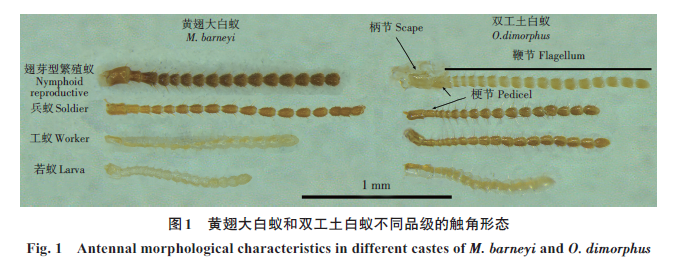
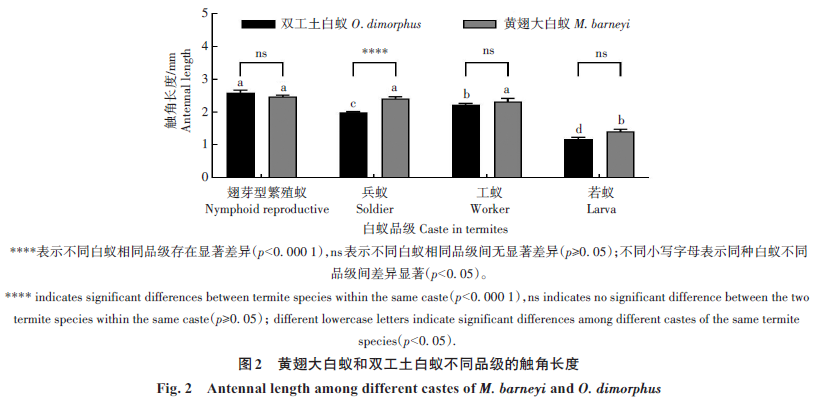
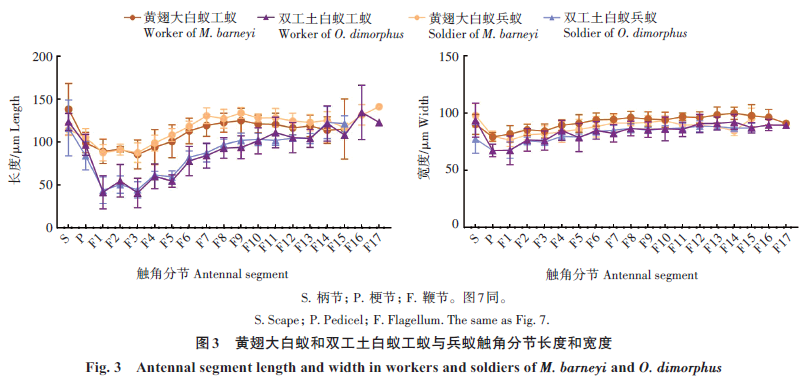
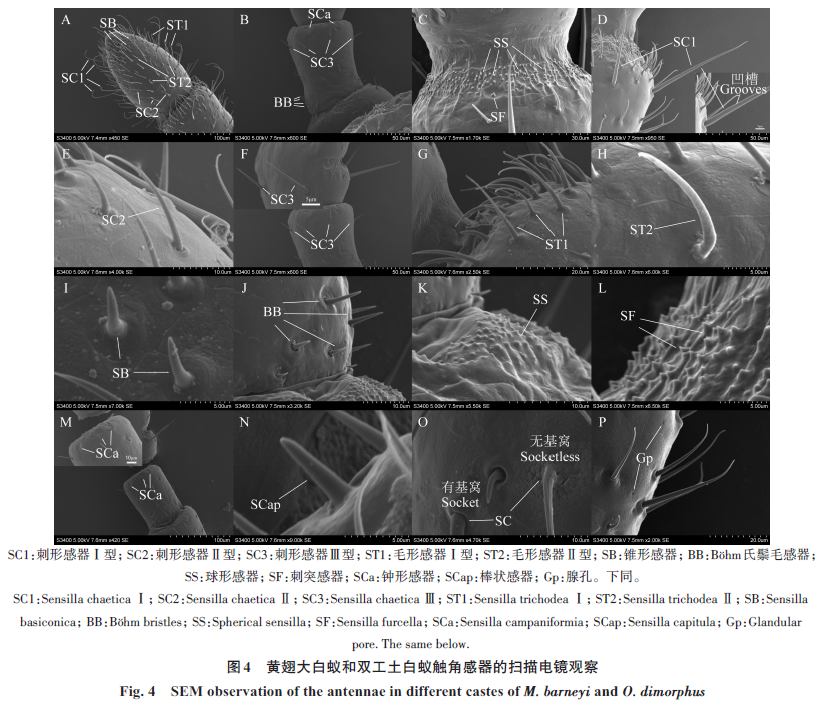
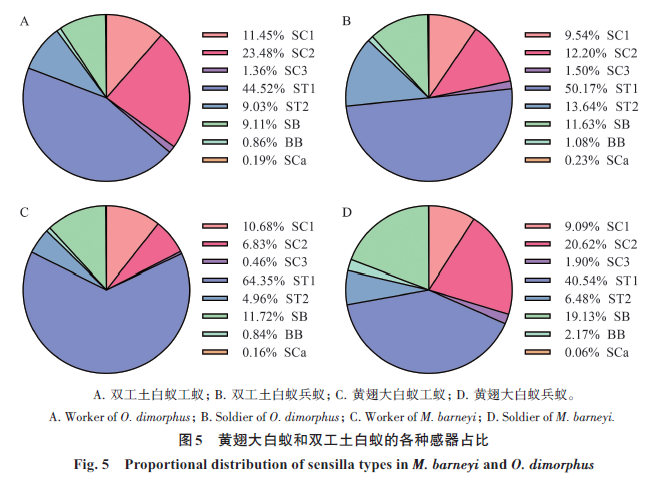
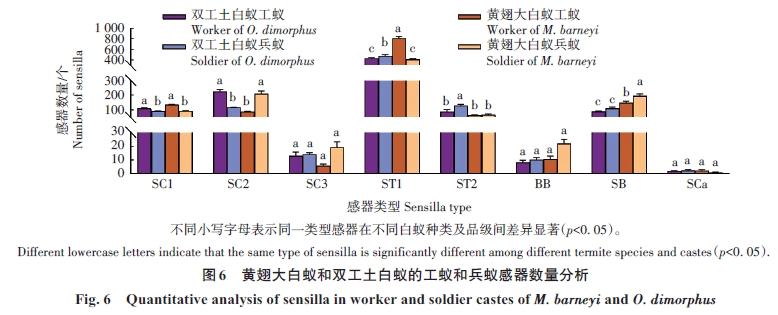
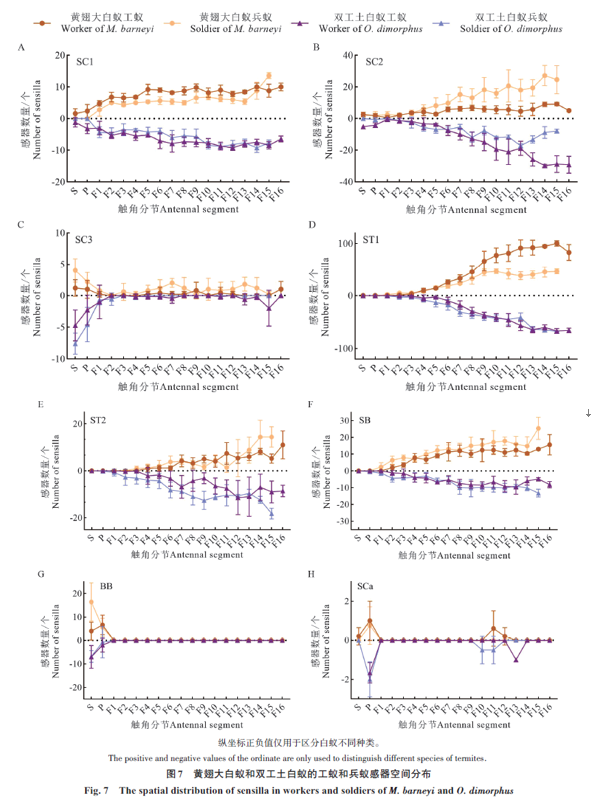
Abstract: As social insects,termites depend on olfactory perception to mediate intraspecific information communication,and antennal sensilla serve as crucial structures for detecting chemical cues.Investigating the morphological diversity and functional adaptation of antennal sensilla is fundamental to unraveling chemical communication mechanisms in termites. In this study,scanning electron microscopy(SEM) was employed to characterize the morphological features and spatial distribution patterns of antennal sensilla in Macrotermes barneyi and Odontotermes dimorphus.The results indicated that wing⁃budded reproductives possessed the longest antennae,whereas nymphs had the shortest antennae in both species. The antennal lengths of soldiers in M.barneyi were significantly greater than soldiers in O.dimorphus.From the scape to flagellum,the length and width of each antennomere initially decreased,then increased and subsequently plateaued. In total,11 sensillum types were identified across the two termite species,consisting of three subtypes of sensilla chaetica,two subtypes of sensilla trichodea,sensilla basiconica,Böhm’s bristles,sensilla globularia,sensilla spinosa,sensilla campaniformia,and sensilla bacilliformia.Clear variations in sensillum abundance were detected in the two termites species.Sensilla trichodea were the most numerous,followed by sensilla chaetica,while sensilla campaniformia were the rarest. In terms of distribution,sensilla chaetica Ⅰ,Ⅱ,sensilla trichodea and sensilla basiconica were predominantly distributed on the flagellomeres,with their quantities increasing toward the apical segments.By contrast,sensilla chaetica Ⅲ,Böhm’s bristles and sensilla campaniformia were largely confined to the scape and pedicel.Significant interspecific and inter⁃caste divergences were observed in the quantity and composition of antennal sensilla.Through interspecific comparisons among workers,O.dimorphus exhibited higher absolute and relative abundance of sensilla chaetica Ⅱ,while M.barneyi possessed more sensilla trichodea Ⅰ and sensilla basiconica;among soldiers,O.dimorphus had a higher proportion of sensilla trichodea Ⅰ,and M.barneyi was characterized by greater proportions of sensilla chaetica Ⅱ and sensilla basiconica.Intraspecific comparisons revealed that workers of O.dimorphus had significantly more sensilla chaetica Ⅰ and Ⅱ but fewer sensilla trichodea than soldiers.For M.barneyi,workers possessed more sensilla chaetica Ⅰ and sensilla trichodea Ⅰ,yet fewer sensilla chaetica Ⅱ and sensilla basiconica compared with soldiers.Overall,the present study describes the morphological structure,spatial distribution,as well as interspecific and inter⁃caste differences of antennal sensilla in the two termite species,providing solid morphological evidence for identifying pheromone receptor regions and exploring the olfactory communication network of termites.

Key words: Macrotermes barneyi, Odontotermes dimorphus, Antenna, Sensilla, Scanning electron microscopy(SEM)

摘要: 社会性昆虫白蚁依赖嗅觉系统进行信息交流,触角感器是其感知化学信号的关键结构,研究白蚁触角感器的种类及功能对揭示白蚁信息交流具有重要意义。利用扫描电镜分析了黄翅大白蚁(Macrotermes barneyi)和双工土白蚁(Odontotermes dimorphus)触角感器的形态和空间分布特征。结果表明,2种白蚁触角均以翅芽型繁殖蚁最长,若蚁最短,黄翅大白蚁兵蚁的触角长度显著长于双工土白蚁兵蚁;从柄节到鞭节,触角各小节长度和宽度均呈先降低再增加后趋于稳定的变化趋势。2种白蚁触角上共发现11种感器,包括刺形感器3个亚型、毛形感器2个亚型、锥形感器、Böhm氏鬃毛感器、球形感器、刺突感器、钟形感器以及棒状感器。2种白蚁不同触角感器数量存在差异,其中毛形感器最多,刺形感器次之,钟形感器最少;空间分布上,刺形感器Ⅰ、Ⅱ型,毛形感器和锥形感器等感器主要集中于鞭节,数量从柄节到顶端鞭节增加,而刺形感器Ⅲ型、Böhm氏鬃毛感器和钟形感器则主要分布在柄节与梗节。2种白蚁触角感器数量与组成存在显著的种间及品级间差异。种间比较,工蚁品级中,双工土白蚁刺形感器Ⅱ型数量及占比更高,黄翅大白蚁的毛形感器Ⅰ和锥形感器数量及占比更具优势;兵蚁品级中,双工土白蚁毛形感器Ⅰ型占比更高,黄翅大白蚁刺形感器Ⅱ型和锥形感器占比更高。同种内,双工土白蚁工蚁刺形感器Ⅰ、Ⅱ型数量显著多于兵蚁,毛形感器数量少于兵蚁;黄翅大白蚁工蚁刺形感器Ⅰ型和毛形感器Ⅰ型数量多于兵蚁,刺形感器Ⅱ型和锥形感器数量少于兵蚁。揭示了黄翅大白蚁和双工土白蚁触角感器的结构、空间分布及种间、品级间差异,为定位信息素受体位点、阐明信息素通讯网络提供了形态学证据。

关键词: 黄翅大白蚁, 双工土白蚁, 触角, 感器, 扫描电镜

CLC Number: