河南农业科学 ›› 2026, Vol. 55 ›› Issue (10): 30-37.DOI: 10.15933/j.cnki.1004-3268.2026.10.004

• 专题:茶树病虫害监测预警及绿色防控 • 上一篇    下一篇

温度对灰茶尺蠖成虫产卵和寿命的影响

耿书宝1,2,杨春玲1,2,侯贺丽3,Jung Chuleui4,刘晓光5,乔利1,2,张方梅1,2   

  1. (1.信阳农林学院 农学院,河南 信阳 464000; 2.河南省大别山实验室,河南 信阳 464000; 3.信阳农林学院 食品科学与工程学院,河南 信阳 464000; 4.庆国大学,韩国 安东 36729; 5.河南农业大学,河南 郑州 450046)
  • 收稿日期:2026-06-09 接受日期:2026-07-29 出版日期:2026-10-15 发布日期:2026-10-28
  • 通讯作者: 张方梅,教授,博士,主要从事昆虫生态学、茶树病虫害绿色防控研究。E-mail:2015180005@xyafu.edu.cn
  • 作者简介:耿书宝,副教授,博士,主要从事昆虫种群生态学、茶树病虫害防控研究。E-mail:shubaogeng@163.com
  • 基金资助:
    国家自然科学基金项目(32402364);河南省重点研发专项(261111114300);河南省大别山实验室重点课题(DMLP006)

Effect of Temperature on Fecundity and Longevity of Ectropis grisescens Adults

Geng Shubao1,2,Yang Chunling1,2,Hou Heli3,Jung Chuleui4,Liu Xiaoguang5,Qiao Li1,2,Zhang Fangmei1,2   

  1. (1.School of Agricultural Science,Xinyang Agriculture and Forestry University,Xinyang 464000,China;2.Henan Dabie Mountain Laboratory,Xinyang 464000,China;3.School of Food Science and Engineering,Xinyang Agriculture and Forestry University,Xinyang 464000,China;4.Gyeongkuk National University,Andong 36729,Korea;5.Henan Agricultural University,Zhengzhou 450046,China)
  • Received:2026-06-09 Accepted:2026-07-29 Published:2026-10-15 Online:2026-10-28

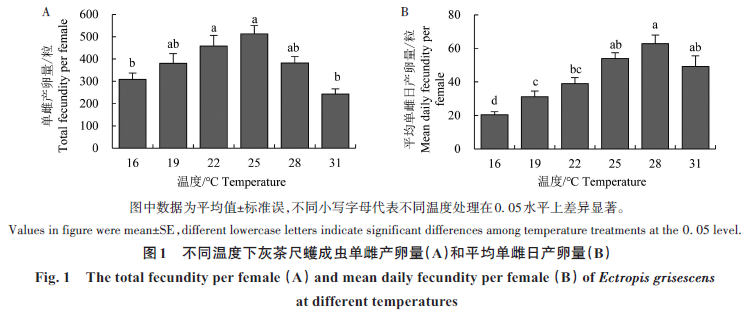
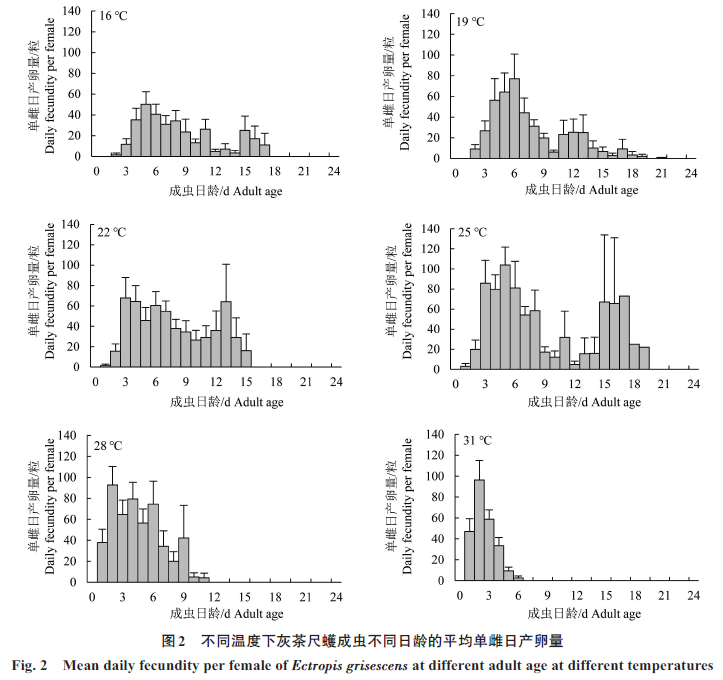
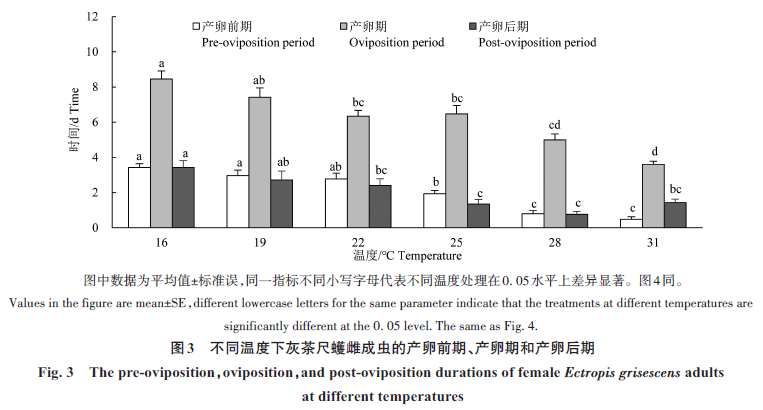
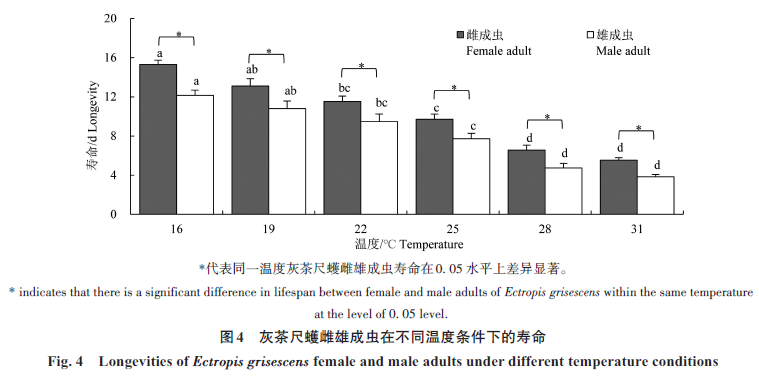
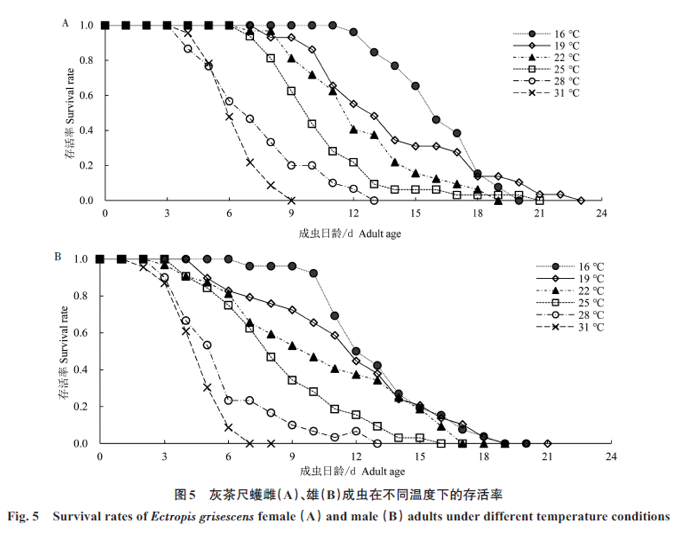
摘要: 为明确不同温度条件下灰茶尺蠖(Ectropis grisescens)成虫寿命、产卵能力的变化规律,阐明其生殖性状的温度响应机制,在人工气候箱内测定了灰茶尺蠖成虫在16、19、22、25、28、31 ℃ 6个温度(相对湿度75%,光周期14L∶10D)下的产卵前期、产卵期、产卵后期、单雌总产卵量、单雌日产卵量及雌雄寿命。结果表明,温度显著影响雌成虫产卵量,单雌总产卵量在25 ℃下最高(512.50粒),在31 ℃下最低(243.22粒);平均单雌日产卵量在28 ℃下最高(62.81粒),在16 ℃最低(20.41粒)。在16~28 ℃下,成虫不同日龄的单雌日产卵量曲线呈双峰分布,31 ℃下仅存在1个产卵峰。不同温度条件下的雌成虫产卵前期、产卵期和产卵后期存在显著差异,产卵前期和产卵期分别从16 ℃下的3.42 d和8.46 d减少到31 ℃下的0.48 d和3.61 d;产卵后期在16 ℃下最长(3.42 d),在28 ℃下最短(0.77 d)。雌雄成虫寿命随温度(16~31 ℃)升高而显著缩短,分别从16 ℃下的15.31 d和12.15 d减少到31 ℃下的5.52 d和3.83 d。同一温度下的雌成虫寿命均显著高于雄成虫。生存分析表明,16 ℃处理雌、雄成虫半数存活时间最长,种群衰减平缓,31 ℃下存活率曲线急剧下降,且雌虫存活率始终高于雄虫。综上,灰茶尺蠖成虫的寿命随温度升高而缩短,雌成虫繁殖的最适温度为25~28 ℃,高温(31 ℃)通过压缩产卵期、抑制产卵量及缩短寿命限制种群增长,为灰茶尺蠖产卵模型构建、信阳茶区发生期预测和绿色防控技术开发提供理论依据。

关键词: 灰茶尺蠖, 温度, 成虫, 产卵量, 寿命

Abstract: To clarify the changes in adult longevity and fecundity of Ectropis grisescens under different temperature conditions and elucidate the temperature⁃response mechanism of its reproductive traits,experiments were conducted in artificial climate chambers. Six temperature treatments(16,19,22,25,28 and 31℃)were set with relative humidity of 75% and a photoperiod of 14L∶10D. Parameters including pre⁃oviposition period,oviposition period,post⁃oviposition period,total fecundity per female,daily fecundity per female,and longevity of female and male adults were measured. The results showed that temperature exerted significant effects on female fecundity. The maximum total fecundity per female(512.50 eggs) was observed at 25 ℃,whereas the minimum value(243.22 eggs)occurred at 31℃. The highest average daily fecundity per female reached 62.81 eggs at 28 ℃,and the lowest was 20.41 eggs at
16 ℃. The curves of daily fecundity per female at different adult ages presented a bimodal distribution within 16—28 ℃,while only one oviposition peak was detected at 31 ℃. Significant differences were found in pre⁃oviposition,oviposition and post⁃oviposition periods across temperatures. The pre⁃oviposition period and oviposition period decreased from 3.42 d and 8. 46 d at 16 ℃ to 0.48 d and 3. 61 d at 31 ℃,respectively. The post⁃oviposition period was the longest(3.42 d) at 16 ℃ and the shortest(0.77 d) at 28 ℃. Longevity of both female and male adults decreased significantly with rising temperature from 16 ℃ to 31 ℃,decreased from 15.31 d and 12.15 d at 16 ℃ to 5.52 d and 3.83 d at 31 ℃. At each given temperature,female adults lived significantly longer than males. Survival analysis indicated that female and male adults at 16 ℃ had the longest median survival time with slow population decline. By contrast,the survival curve dropped sharply at 31 ℃,and female survival rate was consistently higher than that of males. In conclusion,adult longevity of E.grisescens shortened as temperature increased.The optimal reproductive temperature for female adults was 25—28 ℃. High temperature(31 ℃)restricted population growth by shortening the oviposition period,reducing fecundity and curbing adult longevity.These findings provide a theoretical basis for constructing oviposition models,forecasting population occurrence in Xinyang tea plantations,and developing green control technologies for E.grisescens.

Key words: Ectropis grisescens, Temperature, Adult, Fecundity, Longevity

中图分类号: