河南农业科学 ›› 2026, Vol. 55 ›› Issue (5): 107-115.DOI: 10.15933/j.cnki.1004-3268.2026.05.011

• 植物保护 • 上一篇    下一篇

绿色木霉M1M2 固体发酵培养基的筛选优化及其对大豆菌核病的防治效果

王春1,王芊1,曹旭2,孟庆林1,王宇1,于良斌1,李易初1   

  1. (1.黑龙江省农业科学院 植物保护研究所/农业农村部哈尔滨作物有害生物科学观测实验站,黑龙江 哈尔滨 150086;2.黑龙江省科学院 微生物研究所,黑龙江 哈尔滨 150010)
  • 收稿日期:2025-09-10 接受日期:2025-10-29 出版日期:2026-05-15 发布日期:2026-06-01
  • 通讯作者: 李易初,副研究员,硕士,主要从事植物病理研究。E-mail:liyichu0724@163.com
  • 作者简介:王春,副研究员,硕士,主要从事有害生物综合防治研究。E-mail:chunharbin@aliyun.com
  • 基金资助:
    黑龙江省省属科研院所科研业务费青年项目(CZKYF2024-1-C009)

Screening and Optimization of Solid Fermentation Medium for Trichoderma viride M1M2 and Its Controlling Effect on Sclerotinia Stem Rot in Soybean

WANG Chun1,WANG Qian1,CAO Xu2,MENG Qinglin1,WANG Yu1,YU Liangbin1,LI Yichu1   

  1. (1.Institute of Plant Protection,Heilongjiang Academy of Agricultural Sciences/Scientific Observing and Experimental Station of Crop Pests in Harbin,Ministry of Agriculture and Rural Affairs,Harbin 150086,China;2.Institute of Microbiology,Heilongjiang Academy of Sciences,Harbin 150010,China)
  • Received:2025-09-10 Accepted:2025-10-29 Published:2026-05-15 Online:2026-06-01

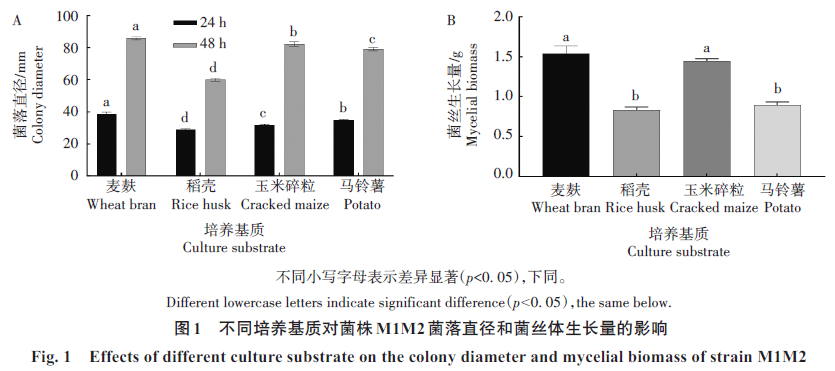
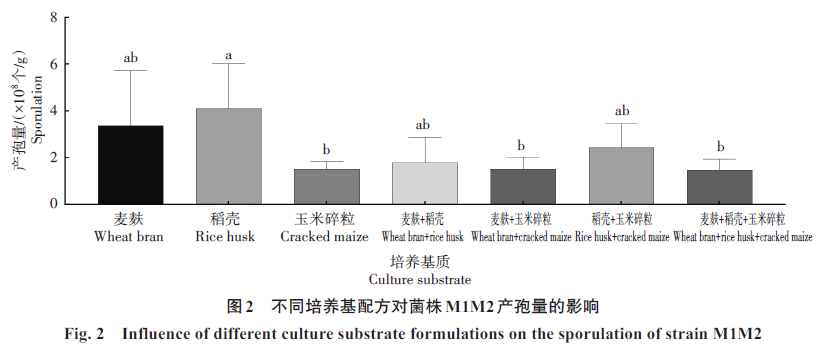
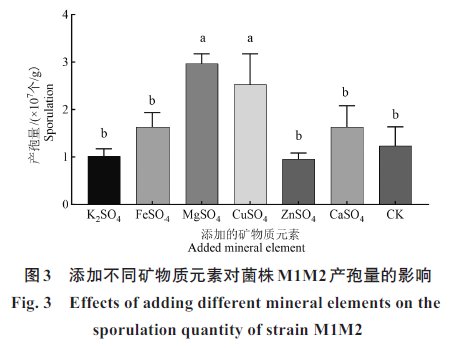
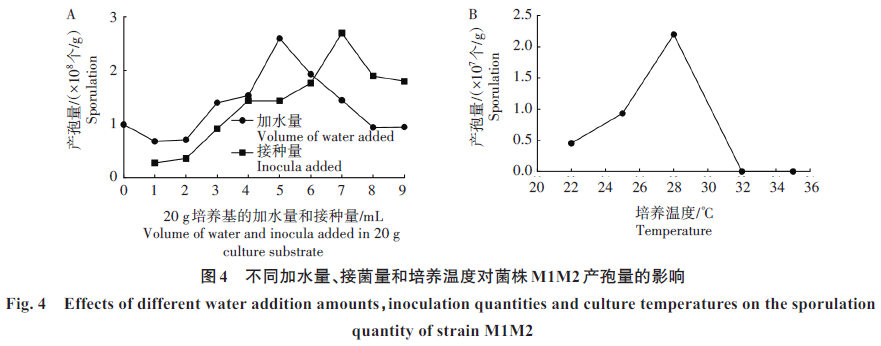
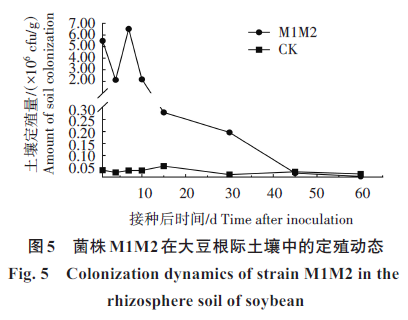
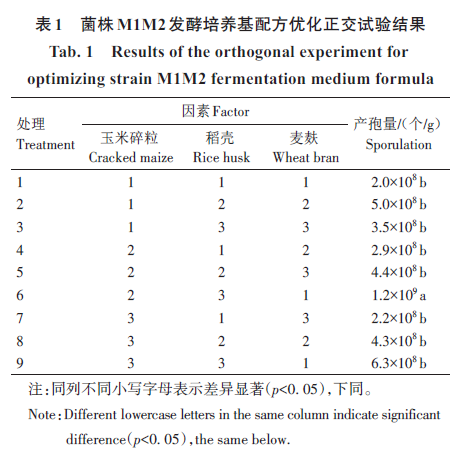
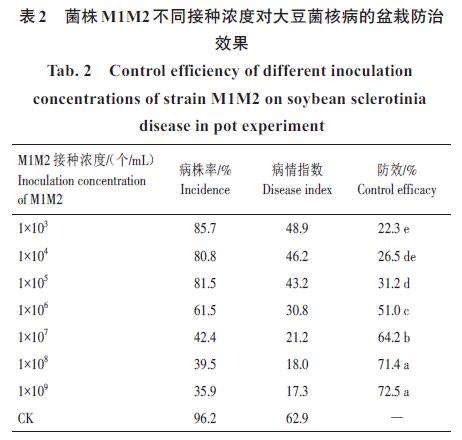
摘要: 以麦麸、稻壳、玉米碎粒等为基质,采用单因素和正交试验筛选绿色木霉菌株M1M2的最佳产孢培养基质配方,探究矿质元素(Fe2+、Mg2+、Cu2+等)对菌株M1M2产孢量的影响,优化接种量、加水量、培养温度等产孢培养条件,并采用盆栽试验测试不同浓度M1M2孢子悬浮液对大豆菌核病的防治效果,利用选择性培养基监测其在土壤中的定殖量变化,旨在为M1M2生防菌剂的开发和应用奠定技术基础。结果表明,菌株M1M2在麦麸和玉米碎粒基质中菌丝生长速度及生物量最大;通过正交试验筛选获得最佳固体发酵基质配方为玉米碎粒∶稻壳∶麦麸=2∶3∶1,在此配方基质中添加Mg²⁺和Cu²⁺可显著促进M1M2产孢。优化后的发酵条件为20 g基质中接种7 mL浓度1×10⁶个/mL的孢子悬浮液、加水量5 mL、培养温度28 ℃,该条件下菌株产孢量达到最大值。盆栽试验显示,M1M2菌株施用浓度≥1×10 cfu/mL时对大豆菌核病的防治效果超过60%,其中1×10 cfu/mL 和1×10 cfu/mL 处理的防效分别达71.4% 和72.5%。M1M2在土壤的定殖分析结果表明,菌株M1M2在施入后第7天定殖量达到峰值(6.5×10 cfu/g),施入30 d后仍维持在2.0×10⁵ cfu/g,为空白对照的10倍。可见,通过培养基质筛选、发酵条件优化及应用技术研究可以实现M1M2菌株的低成本规模化培养,M1M2菌株施用浓度≥1×10 cfu/mL防效较好,为大豆菌核病的生物防治提供了高效菌株及配套应用技术。

关键词: 大豆, 核盘菌, 绿色木霉, 固体发酵培养基, 生物防治, 防效

Abstract: Using wheat bran,rice husk,and cracked maize as substrates,single‐factor and orthogonal experiments were conducted to screen the optimal sporulation medium formulation for Trichoderma viride strain M1M2.The effects of mineral elements(Fe2+,Mg2+,Cu2+,etc.)on sporulation yield were investigated,while inoculum density,moisture content,and incubation temperature were optimized.Pot experiments were conducted to assess the biocontrol efficacy of different M1M2 spore suspension concentrations against sclerotinia stem rot in soybean,and selective media were employed to monitor colonization dynamics in soil,aiming to establish a technical foundation for M1M2 biocontrol agent development and application.The results demonstrated that strain M1M2 achieved maximum mycelial growth rate and biomass in wheat bran and cracked maize substrates.Orthogonal screening identified the optimal solid‐state fermentation formula as cracked maize∶rice husk∶wheat bran=2∶3∶1,with Mg2+ and Cu2+supplementation to this substrate significantly enhancing sporulation. The optimized fermentation conditions comprised inoculation with 7 mL of spore suspension at 1×10⁶ spores/mL in 20 g substrate,water addition of 5 mL,and incubation at 28 ℃,yielding maximum sporulation under these parameters.Pot experiments revealed that M1M2 application concentrations≥1×10⁷ cfu/mL provided>60% control efficacy against sclerotinia stem rot in soybean,with 1×10⁸ cfu/mL and 1×10⁹ cfu/mL treatments achieving 71.4% and 72.5% efficacy,respectively.Soil colonization analysis showed that M1M2 populations peaked at 6.5×10⁶ cfu/g on day 7 post‐application and remained at 2.0×10⁵ cfu/g after 30 days—10‐fold higher than the blank control. These findings indicate that cost‐effective mass production of strain M1M2 can be realized through medium screening,fermentation optimization,and application technology development.The strain exhibits effective biocontrol at concentrations≥1×10⁷ cfu/mL,providing an efficient candidate and compatible application technology for biological management of sclerotinia stem rot in soybean.

Key words: Soybean, Sclerotinia sclerotiorum, Trichoderma viride, Solid fermentation substrate, Biocontrol, Control effect

中图分类号: